Eye Care for Cruise Travelers Visiting Busan, Korea
Introduction
Busan is an important cruise destination in South Korea, and travelers arriving by ship may spend only a limited number of hours or days in the city. For passengers who need an eye examination or eye care during a cruise stop in Busan, planning ahead can make medical care easier to arrange.
Cruise travelers may need eye care for a variety of reasons, including lost glasses, contact-lens problems, dry eye, eye irritation, sudden visual changes, or an existing condition that requires assessment.
Some travelers may also be interested in routine eye examinations or consultations for LASIK, SMILE, SMILE Pro, cataract surgery, ICL, glaucoma, or retinal care while visiting Korea.
However, cruise passengers face an important limitation: time. A routine consultation may be possible during a port visit, but surgery, extensive diagnostic testing, or postoperative follow-up may not fit safely into a short cruise itinerary.
This guide explains how cruise travelers can prepare for eye care in Busan, what services may be appropriate during a short visit, and when an eye problem requires urgent medical attention.
Why Might Cruise Travelers Need Eye Care in Busan?
Common Reasons for an Eye Visit
Travelers may seek ophthalmic care because of:
- Lost or damaged glasses
- Contact-lens discomfort
- Dry eyes
- Eye irritation
- Red eyes
- Blurry vision
- Eye fatigue
- Headaches associated with visual tasks
- New floaters
- Flashes of light
- Existing eye conditions
- Routine eye examinations
The appropriate level of care depends on your symptoms.
Lost or Broken Glasses During a Cruise
A Practical Travel Problem
Losing glasses can make a cruise difficult, particularly if you rely on them for:
- Reading
- Walking safely
- Navigation
- Excursions
- Driving
- Seeing signs
- Everyday activities
If you lose your glasses in Busan, an eye-care or optical provider may be able to help assess your prescription or arrange replacement eyewear.
Bring a copy or photograph of your current prescription if possible.
Contact-Lens Problems During a Cruise
Remove Lenses When They Become Painful
Cruise travelers may experience contact-lens problems because of:
- Dry cabin air
- Long periods of wear
- Swimming
- Poor lens hygiene
- Environmental irritation
- Extended screen use
If contact lenses cause significant pain, redness, light sensitivity, discharge, or reduced vision, remove them and seek professional eye care.
Do not continue wearing uncomfortable lenses simply because you need clear vision.
Dry Eye During Cruise Travel
Travel Conditions Can Affect Eye Comfort
Air-conditioned cabins, wind, sun exposure, and prolonged screen use can contribute to dry-eye symptoms.
You may experience:
- Burning
- Grittiness
- Irritation
- Fluctuating vision
- Watery eyes
- Eye fatigue
- Light sensitivity
Simple measures such as taking screen breaks, blinking regularly, and avoiding direct airflow may improve mild symptoms.
Persistent or significant symptoms should be evaluated.
Eye Care for Cruise Travelers With Diabetes
Do Not Ignore Your Regular Screening Schedule
People with diabetes may need regular retinal examinations even when vision appears normal.
If your cruise itinerary includes Busan and your diabetic eye examination is due, you may be able to arrange an appointment during your stay.
Bring:
- Previous retinal reports
- OCT scans
- Retinal photographs
- Recent HbA1c results
- Medication information
A short cruise stop should not replace an established long-term retinal screening plan.
Eye Care for Travelers With High Myopia
Retinal Health Can Be Important
People with high myopia may have an increased risk of certain retinal problems.
If you have high myopia and develop new:
- Floaters
- Flashes
- Distorted vision
- Peripheral vision changes
during your cruise, seek prompt ophthalmic assessment.
Do not wait until you return home if symptoms are sudden.
Routine Eye Examination During a Busan Cruise Stop
What Can Be Checked?
Depending on your needs and available time, an ophthalmic examination may include:
- Visual acuity
- Refraction
- Eye pressure
- Slit-lamp examination
- Corneal assessment
- Retinal examination
- Additional imaging when clinically appropriate
A routine examination can help identify whether you need further care.
Can Cruise Travelers Get an OCT Scan in Busan?
OCT May Be Available When Clinically Appropriate
OCT, or optical coherence tomography, provides detailed cross-sectional images of structures such as the retina and optic nerve.
It may be useful for patients with:
- Diabetes
- Glaucoma concerns
- Macular disease
- High myopia
- Unexplained visual changes
However, OCT is not automatically required for every traveler.
The ophthalmologist should determine whether it is useful based on your symptoms and examination.
Can Cruise Travelers Get a Glaucoma Check?
Eye Pressure Is Only One Part of the Assessment
Travelers may request glaucoma screening if they have risk factors or a previous diagnosis.
Testing may include:
- Eye pressure measurement
- Optic nerve examination
- OCT
- Visual field testing
- Corneal assessment
A short port visit may be suitable for an initial assessment, but ongoing glaucoma monitoring requires appropriate follow-up.
Retinal Care During a Cruise Stop
New Floaters and Flashes Need Attention
New floaters or flashes may sometimes occur when the vitreous changes inside the eye.
They can also occur with a retinal tear or retinal detachment.
Seek prompt retinal evaluation if you experience:
- A sudden increase in floaters
- New flashes
- A curtain-like shadow
- Sudden peripheral vision loss
- Sudden significant vision reduction
Do not wait until the cruise ends if these symptoms develop.
Can Cruise Travelers Have LASIK in Busan?
A Short Port Visit May Not Be Appropriate
LASIK requires detailed preoperative testing and postoperative monitoring.
A cruise passenger may be able to have a consultation during a Busan visit, but surgery should not be planned solely around a short port stop.
Before considering LASIK, the clinic may need to evaluate:
- Prescription
- Prescription stability
- Corneal topography
- Corneal tomography
- Corneal thickness
- Tear-film health
- Eye pressure
- Overall eye health
You also need enough time for postoperative care.
SMILE and SMILE Pro for Cruise Travelers
Consultation May Be More Practical Than Immediate Surgery
SMILE and SMILE Pro also require comprehensive preoperative evaluation.
A consultation can help determine whether you may be a candidate, but cruise passengers should not assume that treatment can safely be completed between ship arrival and departure.
Discuss your complete travel schedule with the ophthalmologist.
ICL Consultation During a Busan Visit
ICL Requires Detailed Evaluation
ICL is an intraocular procedure.
Evaluation may include:
- Refraction
- Anterior-chamber measurements
- Corneal dimensions
- Eye length
- Endothelial-cell assessment
- Overall eye health
A cruise stop may allow an initial consultation, but surgery and follow-up generally require more time than a short port visit provides.
Cataract Consultation for Cruise Travelers
Routine Assessment May Be Possible
If you are experiencing:
- Increasing glare
- Blurry vision
- Difficulty reading
- Difficulty seeing at night
- Faded colors
you may arrange a cataract consultation in Busan.
The ophthalmologist can assess whether cataract changes or another eye condition may be affecting your vision.
Cataract surgery, however, requires appropriate preoperative planning and postoperative care and should not be treated as a quick cruise-stop procedure.
Eye Care for Older Cruise Travelers
Age-Related Eye Conditions Need Regular Monitoring
Older travelers may have a higher likelihood of:
- Cataracts
- Glaucoma
- Macular conditions
- Retinal disease
- Dry eye
- Presbyopia
If you have an existing eye condition, bring your previous records and medication list.
A short consultation can be useful, but ongoing care should remain coordinated with your regular ophthalmologist.
Eye Care for Children and Families
Family Travel Can Include Eye Concerns
Children may develop:
- Eye irritation
- Contact-lens problems in older children
- Changes in vision
- Eye injuries
Significant eye pain, trauma, or sudden vision changes should receive prompt professional assessment.
Parents should bring relevant prescriptions and previous eye records when available.
English-Speaking Eye Care for Cruise Travelers
Confirm Language Support Before Booking
International travelers may prefer English-language communication.
Before visiting an eye clinic in Busan, confirm whether English is available for:
- Appointment booking
- Registration
- Doctor consultation
- Diagnostic testing
- Medication instructions
- Follow-up
If an interpreter is needed, ask whether one can be available during the medical consultation.
How to Book an Eye Appointment From a Cruise Ship
Contact the Clinic Before Reaching Busan
If you know you may need eye care, contact the clinic as early as possible.
Provide:
- Your arrival date
- Approximate arrival and departure times
- Ship schedule
- Reason for the appointment
- Symptoms
- Language requirements
- Previous diagnosis if applicable
Tell the clinic that you are a cruise passenger with limited time.
How Much Time Should You Allow?
Do Not Schedule Too Tightly
Port schedules can change because of weather, ship operations, transportation delays, and other factors.
Allow time for:
- Travel from the port
- Registration
- Waiting
- Diagnostic testing
- Consultation
- Transportation back to the ship
Do not schedule an appointment so close to your ship's departure that a small delay could cause you to miss boarding.
Transportation From the Cruise Port
Plan Your Route in Advance
Depending on the cruise terminal and clinic location, transportation may involve:
- Taxi
- Bus
- Subway
- Private transportation
If your vision is impaired, avoid driving yourself.
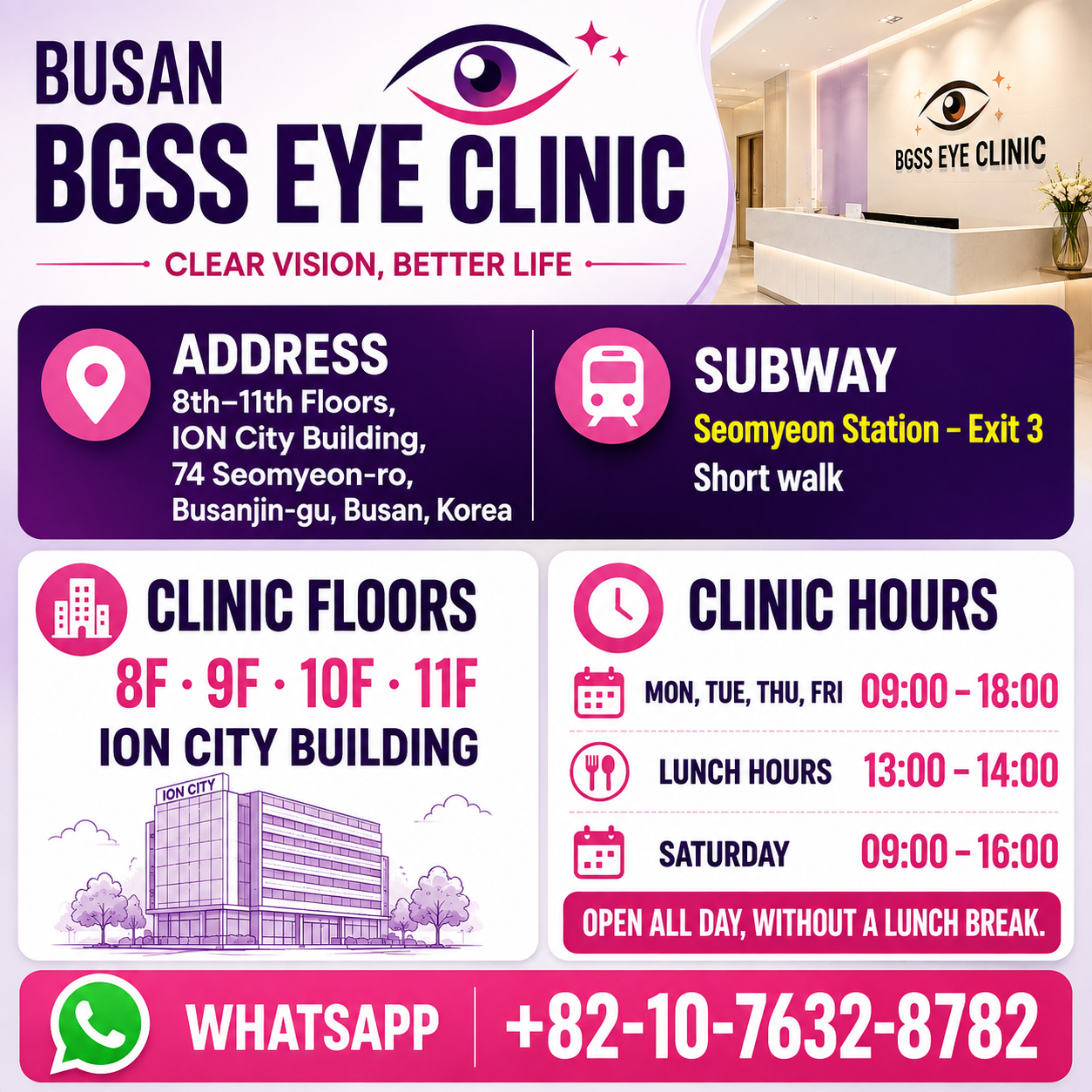
For international patients, keeping the clinic's Korean address on your phone can make transportation easier.
Eye Care Near Central Busan and Seomyeon
A Convenient Area for Medical Visitors
Central Busan and Seomyeon provide convenient access to transportation, hotels, restaurants, shopping, and medical services.
For cruise travelers with several hours available, a central clinic may be easier to reach than a distant location.
However, convenience should not take priority over appropriate medical care.
Same-Day Eye Consultations
Useful for Short-Stay Travelers
Some clinics may offer same-day consultations depending on appointment availability.
A same-day appointment can be useful for:
- Basic eye assessment
- Prescription concerns
- Dry-eye symptoms
- Contact-lens problems
- Initial surgical consultation
However, same-day consultation does not guarantee same-day treatment or surgery.
When Cruise Travelers Need Emergency Eye Care
Do Not Wait for the Ship to Depart
Seek urgent medical assessment for:
- Sudden significant vision loss
- A curtain-like shadow
- Sudden flashes with many new floaters
- Severe eye pain
- Serious eye injury
- Chemical exposure
- Sudden double vision with neurological symptoms
If these symptoms develop, prioritize medical care over continuing your sightseeing itinerary.
What Should You Bring to an Eye Appointment?
Prepare a Small Medical Folder
Bring:
- Passport
- Current glasses
- Current prescription
- Previous eye records
- Contact-lens information
- Medication list
- Allergy information
- Previous surgery records
- OCT or retinal scans when relevant
Digital copies are particularly useful for cruise travelers.
What If You Miss Your Appointment Because of the Cruise Schedule?
Have a Backup Plan
Cruise schedules can change.
If you miss an appointment, contact the clinic as soon as possible.
For urgent symptoms, do not simply wait for another convenient appointment.
Seek appropriate emergency or urgent medical care.
Medical Insurance and Payment
Check Your Travel Coverage
Routine or elective eye care may not be covered by travel insurance in the same way as emergency medical treatment.
Before your cruise, check your insurance policy and understand:
- Emergency eye-care coverage
- Outpatient treatment
- Diagnostic testing
- Prescription medication
- Medical evacuation
- Pre-existing condition exclusions
Ask the clinic about accepted payment methods before your appointment.
Medical Tax Refunds for Cruise Travelers
Confirm Eligibility Before Treatment
Eligible foreign visitors may qualify for certain medical tax-refund arrangements under applicable Korean regulations.
Eligibility depends on the current rules, provider participation, patient status, and specific medical service.
Do not assume that a cruise passenger automatically qualifies.
Ask the clinic before payment if a tax-refund process is available for your treatment.
What Should You Do After an Eye Examination?
Follow the Doctor's Instructions
If you receive eye drops or other treatment, follow the instructions provided.
If your pupils were dilated, ask whether temporary blurred vision or light sensitivity affects your ability to continue sightseeing safely.
If you receive treatment that requires follow-up, discuss whether it can safely be completed after you return home.
Can You Return to Your Cruise Ship After an Eye Exam?
Usually Depends on What Was Done
A routine eye examination may allow you to continue your day, but dilation can temporarily affect near vision and light sensitivity.
After treatment or surgery, however, additional restrictions may apply.
Always follow the ophthalmologist's instructions and allow enough time before returning to the ship.
What Should You Ask the Eye Doctor?
Questions for Cruise Travelers
Consider asking:
- Is my eye healthy?
- Has my prescription changed?
- Do I need additional testing?
- Is my retina healthy?
- Is my eye pressure normal?
- Do I need OCT?
- Can I safely continue my cruise activities?
- Do I need follow-up care?
- Can follow-up be completed in my home country?
- Are there any restrictions on flying or travel?
Conclusion
Eye care for cruise travelers visiting Busan, Korea requires a little more planning because cruise passengers often have limited time in port.
Routine eye examinations, prescription checks, dry-eye assessments, contact-lens evaluations, glaucoma screening, retinal examinations, and initial consultations for vision correction may be possible depending on appointment availability and the patient's needs.
However, LASIK, SMILE, SMILE Pro, ICL, cataract surgery, and other procedures should not be treated as quick cruise-stop activities. These treatments require appropriate preoperative assessment, informed consent, and postoperative follow-up.
For international cruise passengers, contact the clinic before arriving, explain your ship schedule, confirm English-language support if needed, and allow enough time for transportation and unexpected delays.
Most importantly, do not postpone urgent eye care because you are on a cruise. Sudden vision loss, a curtain-like shadow, new flashes with many floaters, severe eye pain, significant trauma, or neurological symptoms require prompt medical assessment.
A well-planned eye appointment can help cruise travelers receive appropriate care in Busan without compromising medical safety or their travel schedule.
FAQs About Eye Care for Cruise Travelers in Busan
1. Can cruise travelers get an eye examination in Busan?
Yes. Cruise passengers can seek ophthalmic care in Busan, subject to clinic availability and appointment requirements.
2. Can I get a same-day eye consultation during my Busan port visit?
Some clinics may offer same-day appointments. Contact the clinic in advance and explain that you are a cruise passenger with limited time.
3. Can I get new glasses in Busan?
You may be able to obtain a new prescription or replacement glasses, depending on the provider and available services. Bring your existing prescription if possible.
4. Can cruise passengers get contact-lens problems treated in Korea?
Yes. Eye clinics can evaluate contact-lens-related irritation and other problems. Remove lenses if they become painful or significantly uncomfortable.
5. Can I get an OCT scan during a cruise stop in Busan?
OCT may be available when clinically appropriate. Ask the clinic whether it can be performed during your appointment.
6. Can I get a glaucoma check in Busan?
Yes. Depending on the clinic, glaucoma evaluation may include eye pressure measurement, optic nerve examination, OCT, and visual field testing.
7. Can cruise travelers get retinal examinations in Busan?
Yes. Retinal evaluation may include a dilated examination and additional imaging when appropriate. New flashes, many floaters, or a curtain-like shadow require urgent assessment.
8. Can I have LASIK during a cruise stop in Busan?
A consultation may be possible, but a short port visit is generally not a suitable basis for assuming that LASIK can safely be completed. Preoperative testing and postoperative follow-up are necessary.
9. Can I have SMILE Pro or ICL during my cruise visit?
You may be able to arrange a consultation, but surgery requires comprehensive evaluation and appropriate follow-up. Discuss your full travel schedule with the ophthalmologist.
10. Are English-speaking eye clinics available in Busan?
Some clinics provide English-language support. Confirm whether English is available for the doctor consultation, testing, consent, medication instructions, and follow-up.
11. Should I schedule an eye appointment close to my ship's departure time?
No. Allow extra time for transportation, waiting, diagnostic testing, and possible delays. You should have enough time to return to the ship safely.
12. When should a cruise traveler seek emergency eye care?
Sudden vision loss, a curtain-like shadow, sudden flashes with many new floaters, severe eye pain, significant trauma, chemical exposure, or neurological symptoms require urgent medical assessment.