

Cataract Surgery in Busan, Korea
Clear vision again, with a lens chosen for the way you live. BGSS removes the clouded natural lens and replaces it with an intraocular lens (IOL) selected after detailed measurements, including options that also correct astigmatism or reduce the need for reading glasses.
Cataract surgery, explained in one minute
Cataract surgery removes the eye’s cloudy natural lens and replaces it with a clear artificial intraocular lens (IOL). It is one of the most commonly performed operations in the world and usually takes less than 30 minutes per eye.
A cataract develops slowly: colours fade, night driving gets harder, lights glare and new glasses stop helping. Surgery does not need to wait until the cataract is “ripe”; it is usually considered once blurred vision starts to affect daily life.
Because the natural lens is replaced, cataract surgery is also a chance to reduce long-standing short-sightedness, long-sightedness, astigmatism or presbyopia, depending on the lens you choose.
How cataract surgery works
Your surgeon explains each step beforehand so you know exactly what to expect.
Preparation
Dilating and numbing eye drops are applied. You stay awake and comfortable throughout.
Removing the cataract
A tiny 2–3 mm opening is made, and the cloudy lens is gently broken up with ultrasound (or softened first with a femtosecond laser) and removed.
Placing the new lens
The folded IOL is inserted and unfolds into position. The small incision normally seals by itself.
Choosing your intraocular lens
BGSS offers a wide range of premium lenses. Your doctor recommends one after measuring your eye and talking about your daily life.
| Lens type | What it does | Good to know |
|---|---|---|
| Monofocal | Sharp vision at one main distance, usually far | Reading glasses are usually still needed |
| Toric | Corrects corneal astigmatism at the same time | Available in monofocal and premium designs |
| Multifocal / trifocal | Far, intermediate and near vision | Some people notice halos around lights at night |
| EDOF (extended depth of focus) | Continuous range from far to intermediate | Light reading glasses may help for small print |
Not every lens suits every eye. Retina health, dry eye, corneal shape and pupil size all affect the choice.
Signs it may be time for cataract surgery
Talk to an ophthalmologist if you notice:
- Blurred, foggy or yellow-tinted vision
- Glare and halos around headlights or street lights
- Difficulty driving at night or reading signs
- Glasses that no longer seem to help
- Frequent prescription changes over a short time
A full eye exam confirms whether a cataract is the cause and whether your eyes are healthy enough for premium lenses.
Your Cataract Surgery trip to Busan
Cataract surgery usually needs a pre-operative exam, the surgery day and at least one check-up afterwards. Coordinators help you plan each visit around your travel dates.
Send your prescription or medical records and travel dates on WhatsApp or KakaoTalk. A coordinator replies with a suggested schedule.
Detailed diagnostic tests and a consultation with your doctor, who confirms the safest option for your eyes.
One eye at a time, usually in under 30 minutes. You go home the same day with a protective shield.
Your doctor checks healing and vision, explains your eye drops, and confirms when you can travel home.
How long to stay in Busan depends on your exam results and the follow-up your doctor recommends. Please confirm your flight dates with your coordinator before booking.
What recovery usually looks like
Vision may be hazy at first and usually improves quickly. Wear the eye shield while sleeping and avoid rubbing your eye.
Use antibiotic and anti-inflammatory drops as prescribed. Avoid heavy lifting, swimming and eye makeup.
Vision continues to settle. Multifocal lenses may take a little longer as the brain adapts.
An IOL does not wear out. If the lens capsule clouds later, a quick YAG laser treatment clears it.
Your doctor confirms your personal recovery plan and when it is safe to fly.

Founded BGSS in 1997 and helped introduce LASEK and presbyopia surgery to Korea. Fellowship at UCLA Jules Stein Eye Institute.
Trusted in Busan since 1997
- Korea’s first generation of vision correction BGSS opened in Busan in 1997 and has performed more than 628,000 procedures in Seoul and Busan, including 330,000+ in Busan.
- Every major option under one roof SMILE Pro, SMILE, LASIK, LASEK, ICL, cataract and presbyopia surgery, so your doctor can recommend what truly suits your eyes.
- Advanced diagnostics Pentacam, CASIA2, Galilei G4, OCT, UBM and more are used to measure your eyes before any treatment.
- Government-recognised Designated by Korea’s Ministry of Health and Welfare as an advanced regenerative medicine institution, and registered for international patients.
- Central Seomyeon location Ion City Building, near Seomyeon Station Exit 7, with care in English and Chinese.
Cataract Surgery in Busan: frequently asked questions
Does cataract surgery hurt?
No. Numbing eye drops are used and most patients feel only light pressure. The procedure usually takes under 30 minutes per eye.
Which lens is best for me?
It depends on your eye measurements, retina health, astigmatism and lifestyle. BGSS offers monofocal, toric, multifocal and EDOF lenses and recommends one after a detailed exam.
Can cataract surgery fix astigmatism or the need for reading glasses?
Yes, for suitable patients. Toric lenses correct astigmatism, and multifocal or EDOF lenses can reduce dependence on reading glasses.
Is laser-assisted cataract surgery available?
Yes. BGSS uses femtosecond laser platforms for laser-assisted cataract surgery where it suits the eye.
Can a cataract come back?
The cataract itself cannot return, but the lens capsule can become cloudy later. This is treated with a quick YAG laser procedure.
Can international patients have cataract surgery in Busan?
Yes. Coordinators support you in English and Chinese and plan the exam, surgery and follow-up visits around your stay.
Book your Cataract Surgery consultation
Send us your prescription and travel dates. Our international team will reply with a suggested schedule.
Appointments are by reservation only. We do not accept walk-in patients.
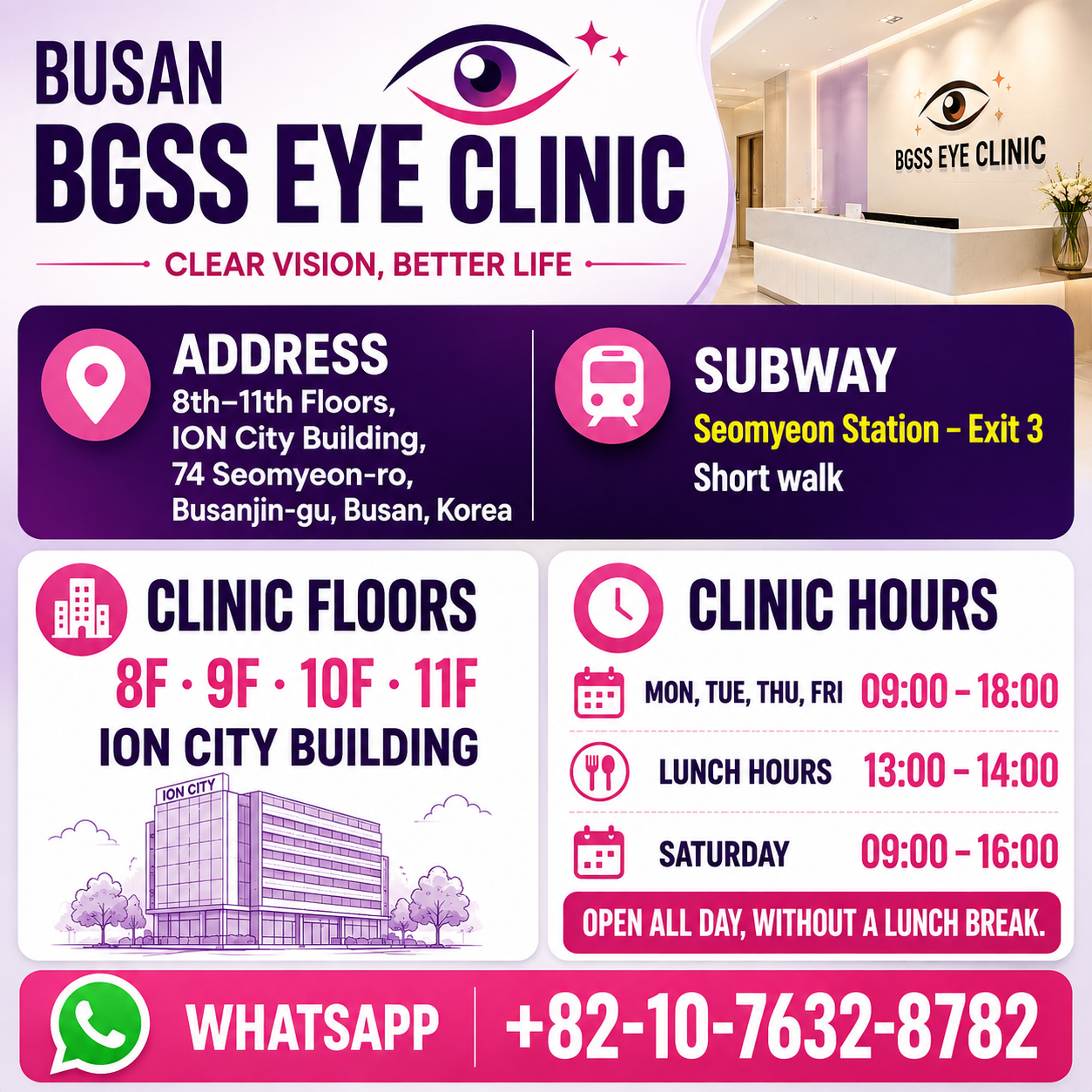
- Address
74 Seomyeon-ro, Busanjin-gu, Busan
Ion City Bldg 8–11F · Seomyeon Station Exit 7 - International Desk +82-10-7632-8782
- Busan Clinic +82-51-805-1100
- Mon · Tue · Thu · Fri 09:00 – 18:00 (lunch 13:00–14:00)
- Saturday 09:00 – 16:00
- Wed · Sun · Holidays Closed