

Viva ICL for Presbyopia in Busan, Korea
A presbyopia-correcting implantable lens for people over 40 who want clear vision near and far without reading glasses, while keeping their own natural lens. Dr. Jong-Ho Lee was the first surgeon in Korea to perform Viva ICL.
Viva ICL, explained in one minute
Viva ICL is an implantable collamer lens designed for presbyopia, the age-related loss of near focus. Placed in front of your natural lens, it corrects near, intermediate and distance vision together, so daily tasks need fewer or no glasses.
Unlike cataract surgery, Viva ICL keeps your natural lens and does not remove corneal tissue. It can also correct nearsightedness at the same time, and cataract surgery remains possible later in life.
BGSS has researched presbyopia correction since 1997, from early techniques to today’s lens-based options.
Benefits of Viva ICL
Near and far
Corrects reading, computer and distance vision together.
Keeps your natural lens
No lens removal, and cataract surgery is still possible later.
No corneal tissue removed
Suitable for thin corneas and after previous laser surgery.
UV protection
The collamer lens blocks UV light.
Removable
The lens can be removed if needed.
Follow-up programme
BGSS offers a follow-up warranty programme.
Who Viva ICL suits
Viva ICL may suit you if you:
- Are 40 or older and need reading glasses
- Want to reduce dependence on glasses for near and far
- Have thin corneas or high myopia
- Have had LASIK or LASEK before
- Do not yet have a cataract that needs surgery
Eligibility is confirmed after a full presbyopia and lens examination.
Your Viva ICL trip to Busan
BGSS is a registered facility for international patients. Our coordinators speak English and Chinese and arrange your schedule before you arrive. Appointments are by reservation only.
Send your prescription or medical records and travel dates on WhatsApp or KakaoTalk. A coordinator replies with a suggested schedule.
Detailed diagnostic tests and a consultation with your doctor, who confirms the safest option for your eyes.
Your treatment is carried out by your BGSS doctor. Plan a quiet rest of the day.
Your doctor checks healing and vision, explains your eye drops, and confirms when you can travel home.
How long to stay in Busan depends on your exam results and the follow-up your doctor recommends. Please confirm your flight dates with your coordinator before booking.
Recovery after Viva ICL
From BGSS’s official aftercare guidance; your doctor gives personal instructions.
Watering or mild pain is common.
Travel after 3–4 days; face washing after 5 days.
Wear goggles while sleeping; light exercise after 2 weeks; night driving after 1–2 weeks.
Makeup after 1 month; strenuous exercise and sauna after 2 months. Any haze settles over 2–3 months.

Appointed ICL instructor in 2006 and the first surgeon in Korea to perform Viva ICL. Has researched presbyopia correction since 1997.
Trusted in Busan since 1997
- Korea’s first generation of vision correction BGSS opened in Busan in 1997 and has performed more than 628,000 procedures in Seoul and Busan, including 330,000+ in Busan.
- Every major option under one roof SMILE Pro, SMILE, LASIK, LASEK, ICL, cataract and presbyopia surgery, so your doctor can recommend what truly suits your eyes.
- Advanced diagnostics Pentacam, CASIA2, Galilei G4, OCT, UBM and more are used to measure your eyes before any treatment.
- Government-recognised Designated by Korea’s Ministry of Health and Welfare as an advanced regenerative medicine institution, and registered for international patients.
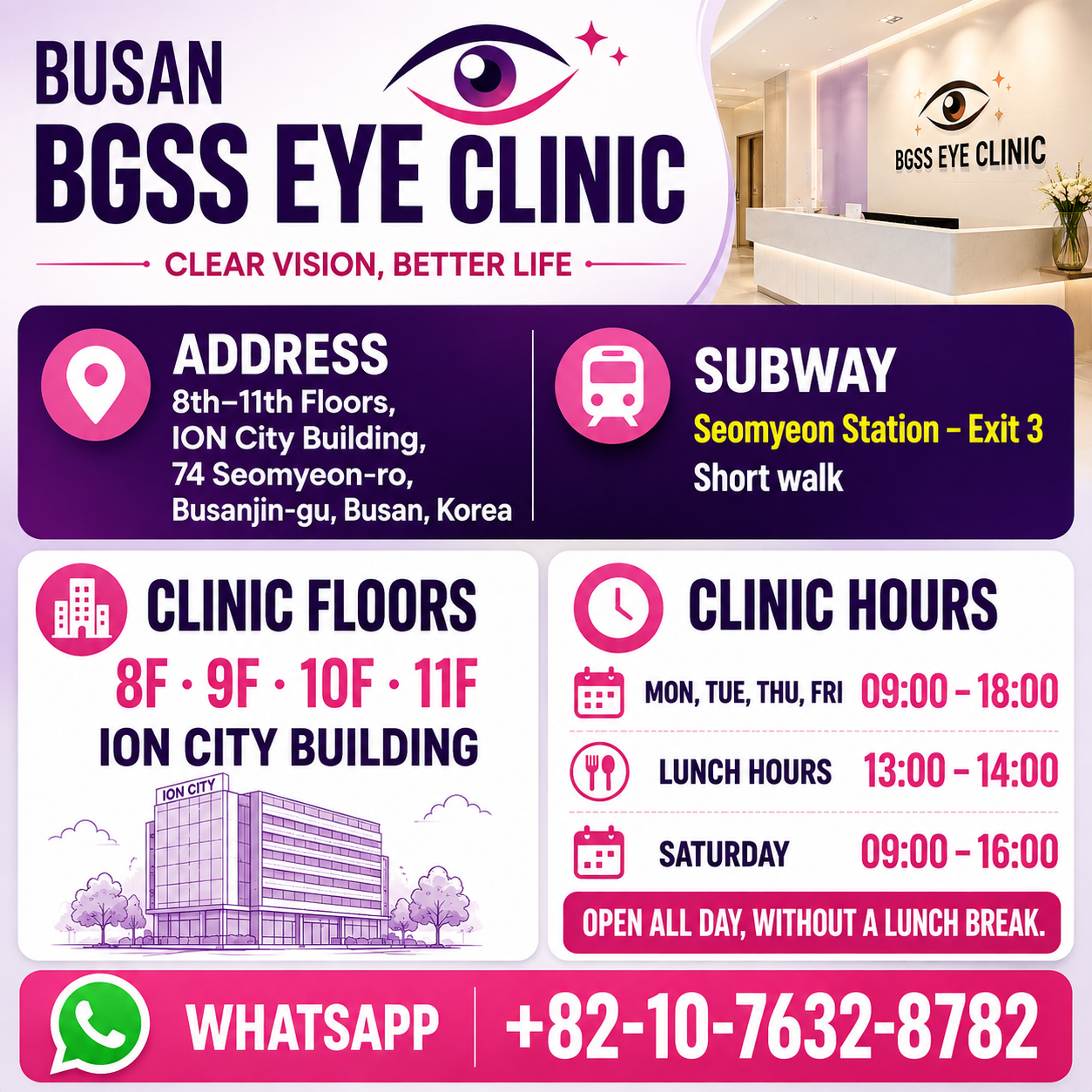
- Central Seomyeon location Ion City Building, near Seomyeon Station Exit 7, with care in English and Chinese.
Viva ICL in Busan: frequently asked questions
What is Viva ICL?
Viva ICL is an implantable collamer lens that corrects presbyopia, giving near, intermediate and distance vision while keeping your natural lens.
Who is Viva ICL for?
It is designed for people aged 40 and over with presbyopia, including those with thin corneas, high myopia or previous LASIK or LASEK.
What results has BGSS seen with Viva ICL?
Results presented at the 2025 VIVA ICL User Meeting: more than 9 in 10 patients had glasses-free daily vision, 83% saw 20/25 or better unaided at one month, and over 98% had best-corrected 20/25 or better at three months.
How is Viva ICL different from cataract surgery?
Viva ICL keeps your natural lens; cataract surgery replaces it. Cataract surgery is still possible later.
How long should I stay in Busan?
Travel is usually possible after 3–4 days. Your doctor confirms your schedule.
Should I stop wearing contact lenses before the exam?
Yes: soft lenses 1 week, toric soft lenses 2 weeks and ortho-K lenses at least 4 weeks before.
Book your Viva ICL consultation
Send us your prescription and travel dates. Our international team will reply with a suggested schedule.
Appointments are by reservation only. We do not accept walk-in patients.
- Address
74 Seomyeon-ro, Busanjin-gu, Busan
Ion City Bldg 8–11F · Seomyeon Station Exit 7 - International Desk +82-10-7632-8782
- Busan Clinic +82-51-805-1100
- Mon · Tue · Thu · Fri 09:00 – 18:00 (lunch 13:00–14:00)
- Saturday 09:00 – 16:00
- Wed · Sun · Holidays Closed