

Revision ICL Surgery in Busan, Korea
For blurred vision after previous LASIK or LASEK, or concerns with an existing ICL. When the cornea is too thin for repeat laser surgery, an ICL can correct the remaining prescription without touching the cornea again.
Revision ICL, explained in one minute
Revision ICL uses an implantable collamer lens to correct vision that has drifted after previous laser surgery, or reviews and adjusts an existing ICL. Because the lens sits inside the eye, it adds correction without removing more corneal tissue.
After LASIK or LASEK, myopia can return or the cornea can change shape. If the remaining corneal thickness is below the safety limit, a second laser treatment may risk haze, epithelial ingrowth or corneal weakening (ectasia). An ICL avoids those risks.
For patients with an existing ICL, BGSS evaluates the lens vault, position and rotation and discusses whether repositioning, exchange or removal is needed.
Cause first, surgery last
Re-correction is only planned once your eyes are stable.
Find the cause
Detailed tests identify why vision changed: regression, corneal shape change, dry eye or lens position.
Treat underlying issues
Dry eye management or specialist referral comes first where needed.
Correct when stable
Once your eyes are stable, the ICL is sized to your eye and implanted, or an existing ICL is adjusted.
Six advantages over repeat laser
From BGSS’s official re-correction guidance.
No change to the cornea
The remaining cornea is left untouched.
Minimal regression
Correction comes from the lens, not further reshaping.
No epithelial ingrowth
No flap is lifted again.
Minimal haze
No new surface ablation.
Less dry eye
Corneal nerves are not cut again.
Very low ectasia risk
Avoids further corneal weakening.
Who revision ICL suits
Revision may be considered if you:
- Had LASIK or LASEK and your nearsightedness has returned
- Have a thin or flat central cornea after previous surgery
- Have an irregular corneal surface with dry eye
- Have an existing ICL with vault, rotation or vision concerns
- Have enough space inside the eye and a healthy endothelium
Bring your previous surgery records if you have them. Eligibility is confirmed after examination.
Your Revision ICL trip to Busan
Re-correction may need more than one visit. Coordinators help you plan around your exam results.
Send your prescription or medical records and travel dates on WhatsApp or KakaoTalk. A coordinator replies with a suggested schedule.
Detailed diagnostic tests and a consultation with your doctor, who confirms the safest option for your eyes.
ICL implantation or adjustment once your eyes are stable.
Your doctor checks healing and vision, explains your eye drops, and confirms when you can travel home.
How long to stay in Busan depends on your exam results and the follow-up your doctor recommends. Please confirm your flight dates with your coordinator before booking.

Founded BGSS in 1997 and helped introduce LASEK and presbyopia surgery to Korea. Fellowship at UCLA Jules Stein Eye Institute.
Trusted in Busan since 1997
- Korea’s first generation of vision correction BGSS opened in Busan in 1997 and has performed more than 628,000 procedures in Seoul and Busan, including 330,000+ in Busan.
- Every major option under one roof SMILE Pro, SMILE, LASIK, LASEK, ICL, cataract and presbyopia surgery, so your doctor can recommend what truly suits your eyes.
- Advanced diagnostics Pentacam, CASIA2, Galilei G4, OCT, UBM and more are used to measure your eyes before any treatment.
- Government-recognised Designated by Korea’s Ministry of Health and Welfare as an advanced regenerative medicine institution, and registered for international patients.
- Central Seomyeon location Ion City Building, near Seomyeon Station Exit 7, with care in English and Chinese.
Revision ICL in Busan: frequently asked questions
What is revision ICL?
Revision ICL uses an implantable lens to correct vision after previous LASIK or LASEK, or reviews and adjusts an existing ICL, without removing more corneal tissue.
Why not repeat LASIK or LASEK?
If the remaining cornea is thin, repeat laser surgery may risk haze, epithelial ingrowth, keratoconus-like weakening or loss of vision. An ICL avoids further corneal thinning.
What results has BGSS seen?
In a BGSS case series of 10 patients who had LASIK or LASEK elsewhere (myopia −0.50 to −3.50 D before ICL), all reached 20/20 to 20/16 after ICL.
Can an existing ICL be exchanged or removed?
Yes. After examining the vault, position and rotation, your doctor discusses whether repositioning, exchange or removal is appropriate.
What should I bring?
Your previous surgery records, glasses prescription and any recent eye test results.
Can international patients have revision surgery in Busan?
Yes. Coordinators support you in English and Chinese and help plan any extra visits.
Book your Revision ICL consultation
Send us your prescription and travel dates. Our international team will reply with a suggested schedule.
Appointments are by reservation only. We do not accept walk-in patients.
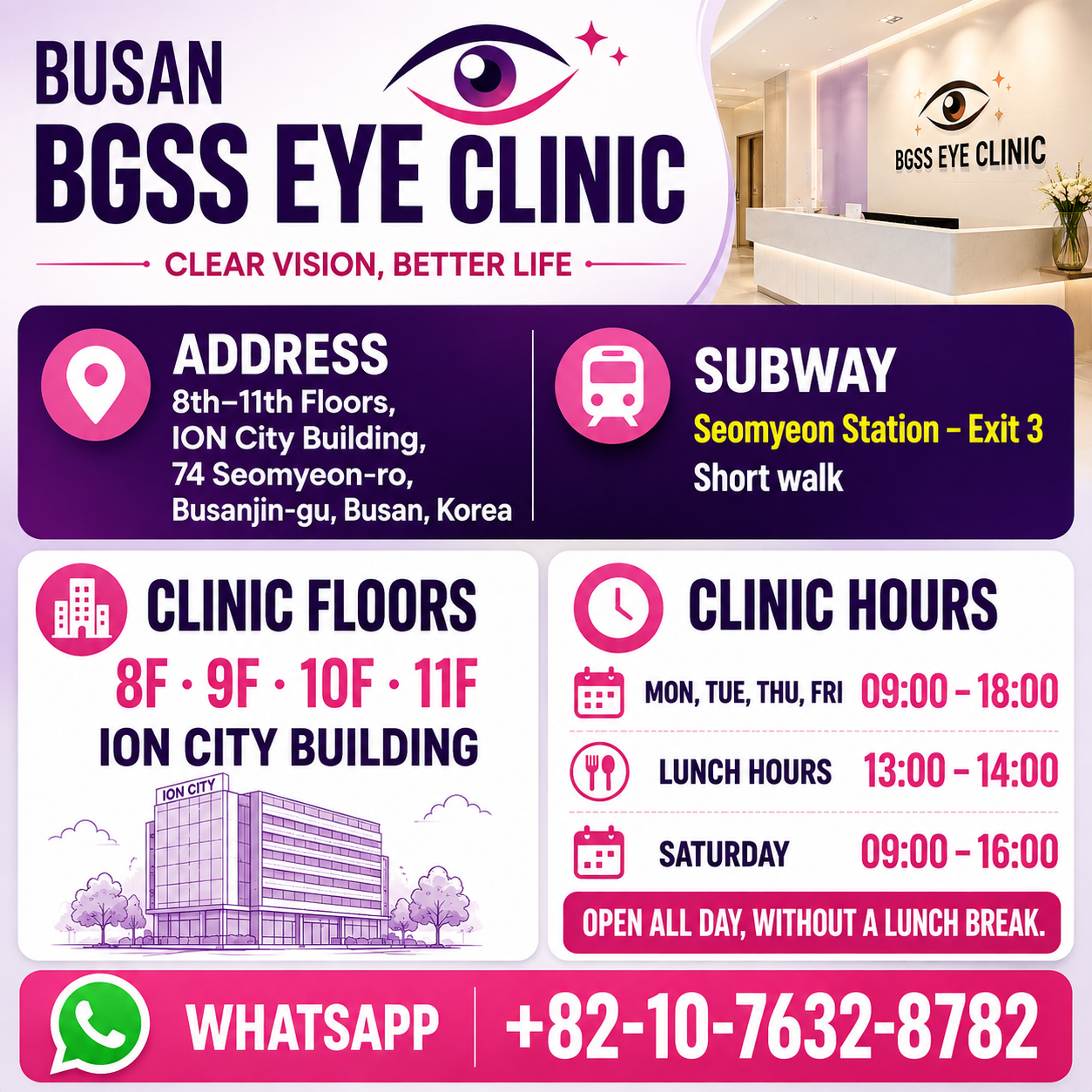
- Address
74 Seomyeon-ro, Busanjin-gu, Busan
Ion City Bldg 8–11F · Seomyeon Station Exit 7 - International Desk +82-10-7632-8782
- Busan Clinic +82-51-805-1100
- Mon · Tue · Thu · Fri 09:00 – 18:00 (lunch 13:00–14:00)
- Saturday 09:00 – 16:00
- Wed · Sun · Holidays Closed