Where to Get an Eye Exam Before Flying From Busan, Korea
Introduction
If you are preparing to fly home from Busan after a vacation, business trip, medical-tourism visit, or cruise, an eye exam before flying from Busan, Korea can be useful when you have new visual symptoms, an existing eye condition, or have recently undergone eye treatment.
For many travelers, the examination may be as simple as checking a prescription or evaluating dry-eye symptoms. Others may need a more detailed assessment involving eye pressure measurement, retinal examination, OCT, or other diagnostic testing.
The most important consideration is why you need the examination and how soon you are scheduled to fly.
A routine eye examination is different from postoperative clearance, and both are different from emergency eye care. If you have sudden vision loss, a curtain-like shadow, severe eye pain, or other serious symptoms, you should seek urgent medical care rather than waiting for a convenient pre-flight appointment.
Why Have an Eye Exam Before Flying From Busan?
Check Your Vision Before a Long Journey
An eye examination may be useful before flying if you have noticed:
- Blurred vision
- Difficulty seeing road signs
- Eye fatigue
- Headaches
- Dryness
- Light sensitivity
- Difficulty reading
- Changes in your glasses prescription
- New floaters
- Flashes of light
A pre-flight examination can help determine whether the symptoms are related to a refractive error, dry eye, cataract, retinal problem, glaucoma, or another condition.
Eye Exams for Medical Tourists
Especially Important After Eye Treatment
If you came to Busan for an eye procedure, a postoperative examination before returning home may be appropriate.
Depending on the procedure, this could include:
- LASIK
- SMILE
- SMILE Pro
- ICL
- Cataract surgery
- Retinal treatment
- Other ophthalmic procedures
Your treating surgeon should determine whether you are ready to travel.
Do not rely on a generic number of days after surgery as proof that you are safe to fly.
Flying After LASIK or Laser Vision Correction
Get Clearance From Your Surgeon
After uncomplicated laser vision correction, some patients can travel relatively soon, but the timing depends on healing and the surgeon's assessment.
Before leaving Busan, ask:
- Has my eye healed appropriately?
- Is my vision stable enough for travel?
- Is my eye pressure satisfactory?
- Do I need another postoperative examination?
- Which eye drops should I continue?
- What symptoms require urgent care after I return home?
A recent postoperative examination can be particularly useful for international patients because the treating clinic may not be available after you leave Korea.
Flying After Cataract Surgery
Postoperative Follow-Up Matters
Patients who have undergone cataract surgery may need an early follow-up examination before traveling.
The ophthalmologist may assess:
- Visual acuity
- Eye pressure
- Wound or incision healing
- Inflammation
- Intraocular lens position
- Retinal health when indicated
Your surgeon should give you specific travel instructions based on your recovery.
Flying After Retinal Surgery
A Critical Exception: Intraocular Gas
Retinal surgery requires particular caution.
If a gas bubble has been placed inside the eye, you must not fly until your retina specialist confirms that the gas bubble has completely resolved. Changes in cabin pressure can cause the gas to expand and dangerously increase eye pressure.
If you have recently had retinal surgery, tell every eye-care professional and airline-related medical service about the procedure before traveling.
Eye Dilation Before a Flight
Plan Around Temporary Blurred Vision
A comprehensive eye examination may involve pupil dilation when the ophthalmologist needs a better view of the retina.
After dilation, vision can remain blurry and eyes can be more sensitive to light for several hours. The National Eye Institute recommends arranging transportation rather than driving yourself if your vision is affected.
Mayo Clinic similarly notes that dilation can temporarily affect vision and make driving or work inconvenient for several hours.
If you are flying later the same day, tell the clinic about your flight schedule before the examination.
Where Can You Get an Eye Exam in Busan?
Central Busan and Seomyeon Options
If you are staying in central Busan, several ophthalmology clinics are located around the Busanjin-gu and Seomyeon area.
For example:
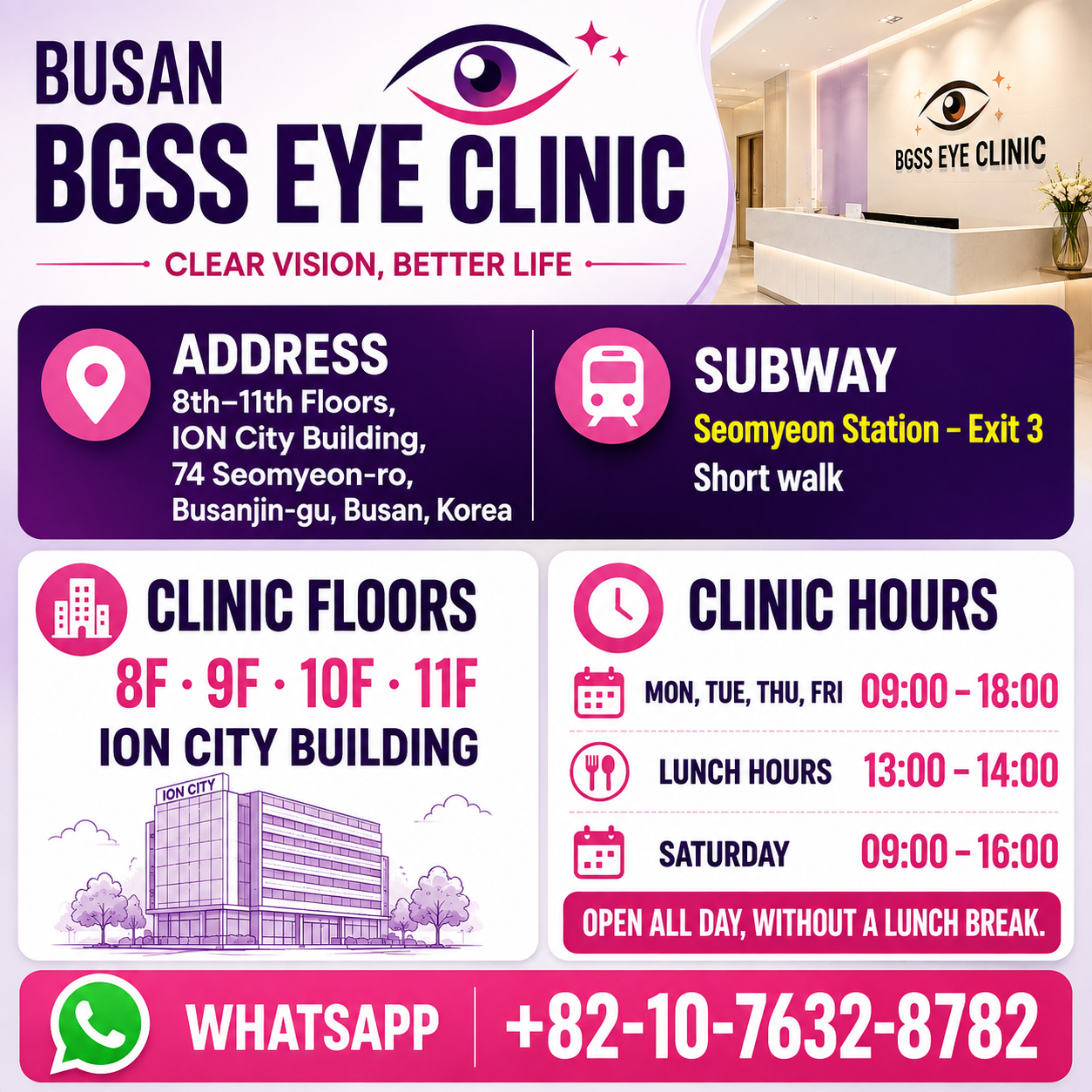
- BGSS Eye Clinic — located on Seomyeon-ro in Busanjin-gu.
- Eye City Eye Hospital — located on Jungang-daero in Busanjin-gu.
- 부산하늘안과의원 — located on Jungang-daero in Bujeon-dong.
- Nunevit Eye Clinic — located on Bujeon-ro in Busanjin-gu.
- Good Person Eye Clinic — located on Seomyeonmunhwa-ro in Busanjin-gu.
These are examples of ophthalmology providers in central Busan; confirm appointment availability, diagnostic services, language support, and travel-related postoperative clearance directly with the clinic before visiting.
Eye Care Near Haeundae
Useful for Travelers Staying Near the Coast
If you are staying around Haeundae rather than central Busan, you may prefer an ophthalmology provider closer to your hotel.
부산성모안과병원 is an ophthalmology provider on Haeun-daero in Haeundae-gu.
For simple replacement eyewear rather than medical eye care, optical stores may also be available in Haeundae. However, significant pain, sudden vision changes, or suspected retinal problems require an ophthalmologist rather than an optical shop.
What Should You Bring to Your Pre-Flight Eye Exam?
Prepare Your Eye Records
Bring:
- Passport or identification
- Current glasses
- Current prescription
- Previous eye examination reports
- OCT scans
- Retinal photographs
- Visual field results
- Previous surgical records
- Medication list
- Allergy information
- Contact-lens information
If you recently had surgery in Korea, bring the procedure details and postoperative instructions.
Digital copies are especially useful when you are preparing to return to another country.
What Tests Might Be Performed?
The Examination Depends on Your Reason for Flying
A routine examination may include:
- Visual acuity
- Refraction
- Eye pressure
- Slit-lamp examination
- Corneal assessment
If there is a retinal or glaucoma concern, additional testing may include:
- Dilated retinal examination
- OCT
- Visual field testing
- Retinal photography
- Ocular ultrasound in selected situations
Not every traveler needs every test.
Eye Exam Before Flying for Contact-Lens Users
Pay Attention to Pain and Redness
Contact-lens users may develop dry eye or irritation during travel.
Before flying, seek an eye examination if you have:
- Persistent redness
- Eye pain
- Light sensitivity
- Discharge
- Reduced vision
- Significant lens intolerance
Remove contact lenses if they are painful or significantly uncomfortable.
A corneal infection or other contact-lens complication should not be ignored before a long international flight.
Eye Exam Before Flying With Diabetes
Retinal Health May Need Attention
People with diabetes may require regular retinal monitoring.
If you are due for diabetic eye screening before returning home, an examination in Busan may be useful.
Depending on your medical history, the ophthalmologist may recommend:
- Dilated retinal examination
- Retinal photography
- OCT
- Other retinal imaging
Bring your previous retinal records and recent diabetes information when available.
Eye Exam Before Flying With High Myopia
Check New Floaters or Flashes Promptly
High myopia can be associated with increased retinal risk.
If you notice new:
- Floaters
- Flashes
- Peripheral vision loss
- Distortion
- A curtain-like shadow
do not treat the examination as a routine pre-flight check.
Seek prompt retinal assessment before traveling.
Can You Fly After an Eye Exam?
A Routine Examination Usually Does Not Prevent Travel
A routine eye examination itself does not generally mean that you cannot fly.
However, if your pupils have been dilated, you may temporarily experience blurred vision and light sensitivity.
If you have received treatment or undergone surgery, the travel decision depends on the procedure and your clinical condition.
Ask your ophthalmologist specifically whether you are cleared to fly on your planned date.
Should You Get Your Eyes Dilated Before Flying?
Dilation Depends on Your Medical Needs
Dilation is not automatically required for every eye examination.
It may be particularly useful when assessing the retina, especially in patients with diabetes, high myopia, flashes, floaters, previous retinal disease, or other risk factors.
If a dilated examination is medically appropriate, tell the ophthalmologist that you have a flight afterward so you can plan transportation and timing appropriately.
What If You Have New Floaters Before Your Flight?
Do Not Wait Until You Reach Your Home Country
A sudden increase in floaters can sometimes be associated with a retinal tear or retinal detachment.
Seek urgent eye assessment if floaters occur with:
- Flashes
- A curtain-like shadow
- Peripheral vision loss
- Sudden vision reduction
A dilated retinal examination may be necessary.
What If You Have Sudden Vision Loss Before Flying?
Do Not Board the Plane Before Medical Assessment
Sudden significant vision loss should be treated as an emergency.
Do not simply schedule a routine pre-flight eye examination.
Seek urgent ophthalmic or emergency medical assessment, particularly if vision loss is accompanied by:
- Severe eye pain
- New flashes
- Many new floaters
- Curtain-like shadow
- Severe headache
- Weakness or numbness
- Difficulty speaking
- Other neurological symptoms
What If You Have Eye Pain Before a Flight?
Pain Can Change the Urgency
Mild dryness may improve with appropriate eye care.
However, significant eye pain—especially with blurred vision, halos, nausea, severe headache, redness, or light sensitivity—requires prompt medical assessment.
Do not wait until boarding time to decide whether the symptoms are serious.
How Much Time Should You Allow Before Your Flight?
Avoid Scheduling Too Close to Departure
If your flight leaves Busan later the same day, leave enough time for:
- Transportation
- Registration
- Examination
- Diagnostic testing
- Dilation if needed
- Doctor consultation
- Unexpected additional testing
If postoperative clearance is required, schedule the examination early enough that the surgeon has time to address any concerns.
Transportation to the Airport
Do Not Drive if Your Vision Is Impaired
If you have had dilation, significant visual symptoms, or recent eye surgery, arrange transportation rather than driving yourself.
Depending on your location and airport, you may use:
- Taxi
- Bus
- Subway
- Private transportation
- Airport transfer services
If your vision is impaired, ask someone to accompany you when appropriate.
Eye Care for Cruise Travelers Leaving Busan
A Pre-Flight Examination May Also Be a Pre-Cruise Travel Check
If you are leaving Busan after a cruise or other short visit, the same principles apply.
A routine examination may be useful for:
- Lost glasses
- Prescription changes
- Dry eye
- Contact-lens problems
- Existing eye conditions
But urgent symptoms should receive immediate assessment regardless of your travel schedule.
English-Speaking Eye Examinations in Busan
Confirm Communication Before Booking
International patients may want English-language support for:
- Registration
- Medical history
- Diagnostic testing
- Doctor consultation
- Medication instructions
- Travel clearance
- Follow-up recommendations
Do not assume that every clinic provides English communication at every stage.
Medical Tourism and Postoperative Records
Ask for Documentation Before Leaving Korea
If you received eye treatment in Busan, ask for copies of:
- Diagnosis
- Examination results
- Surgery report
- Prescription
- Medication instructions
- OCT or retinal images
- Postoperative findings
- Follow-up recommendations
These records can help your ophthalmologist at home continue your care.
What Should You Ask Before Your Flight?
Important Questions for the Ophthalmologist
Ask:
- Am I medically cleared to fly?
- Do I need another examination before departure?
- Are my pupils going to be dilated?
- Will dilation affect my ability to travel independently?
- Do I need to continue eye drops?
- Can I safely carry my medications through the airport?
- What symptoms require urgent care after I return home?
- When should I see an ophthalmologist again?
- Can you provide my records in English?
- Do I need any restrictions on air travel?
Pre-Flight Eye Care Checklist
Before Leaving Busan
☐ Complete any recommended eye examination
☐ Confirm whether dilation is necessary
☐ Bring sunglasses if your pupils are dilated
☐ Obtain copies of important medical records
☐ Pack prescribed eye drops in your hand luggage
☐ Confirm your medication schedule
☐ Ask whether you are medically cleared to fly
☐ Arrange transportation if your vision is blurred
☐ Save your clinic's contact information
☐ Know the warning signs that require urgent care
Conclusion
Knowing where to get an eye exam before flying from Busan, Korea can be particularly useful for international patients, medical tourists, cruise travelers, and expats who want to make sure their eyes are stable before a long journey.
Central Busan and Seomyeon have multiple ophthalmology providers, while Haeundae also has established eye-care options. The right clinic depends on your location, symptoms, required testing, and whether you need routine screening or postoperative assessment.
A routine eye exam may include visual acuity, refraction, eye pressure measurement, slit-lamp examination, and additional retinal or diagnostic testing when appropriate.
If you have recently undergone LASIK, SMILE, SMILE Pro, ICL, cataract, or retinal treatment, ask your treating ophthalmologist specifically whether you are cleared to fly. The timing depends on the procedure, healing, and individual findings. Retinal surgery involving an intraocular gas bubble is a particularly important exception because flying can be dangerous until the gas has completely resolved.
Most importantly, do not treat sudden vision loss, a curtain-like shadow, many new floaters, flashes, severe eye pain, or neurological symptoms as routine pre-flight concerns. These symptoms require urgent medical assessment before you consider boarding a flight.
For international travelers, the safest approach is to complete necessary examinations early, keep your medical records accessible, carry prescribed eye drops in your hand luggage, and obtain clear travel instructions from your ophthalmologist before leaving Korea.
FAQs About Eye Exams Before Flying From Busan
1. Where can I get an eye exam before flying from Busan?
International travelers can seek ophthalmic examinations at eye clinics and hospitals throughout Busan. Central Busan and Seomyeon have several ophthalmology providers, including BGSS Eye Clinic and Eye City Eye Hospital. Confirm services and appointment availability before visiting.
2. Can I have an eye exam on the same day as my flight?
It may be possible, but it is better to allow sufficient time for examination, testing, possible dilation, and transportation. If your pupils are dilated, temporary blurry vision and light sensitivity can make independent travel or driving more difficult.
3. Can I fly after an eye examination?
A routine eye examination generally does not prevent flying. However, dilation can temporarily cause blurred vision and light sensitivity, while recent eye surgery may require specific travel clearance.
4. Can I fly after LASIK in Korea?
Some patients can travel relatively soon after uncomplicated LASIK, but you should follow your surgeon's individual clearance and attend any required postoperative examination before departure.
5. Can I fly after cataract surgery in Korea?
Travel timing varies according to healing and the surgeon's assessment. Ask your ophthalmologist whether your eye is stable enough to fly and whether you need a postoperative examination before departure.
6. Can I fly after retinal surgery?
If retinal surgery involved an intraocular gas bubble, you must not fly until your retina specialist confirms that the gas has completely resolved.
7. Should I have my eyes dilated before flying?
Dilation depends on your symptoms, age, risk factors, and the purpose of the examination. If retinal evaluation is medically appropriate, your ophthalmologist may recommend it even if you have a flight afterward.
8. What if I see flashes or many new floaters before my flight?
Seek prompt retinal evaluation rather than waiting until you reach your destination. These symptoms can sometimes indicate a retinal tear or detachment.
9. What if I suddenly lose vision before flying?
Do not board the flight. Seek urgent ophthalmic or emergency medical assessment, particularly if the vision loss is significant or accompanied by pain, flashes, floaters, a curtain-like shadow, or neurological symptoms.
10. Should international patients bring their eye records to the airport?
Keep important medical records, prescriptions, medication information, and postoperative instructions accessible during travel. Digital copies can be particularly useful.