Can Expats Living in Busan Get SMILE Pro Surgery?
Can Expats Living in Busan Get SMILE Pro Surgery?
Yes. Expats living in Busan can get SMILE Pro surgery in Korea if they meet the medical requirements for laser vision correction. Being a foreign resident does not automatically prevent you from receiving SMILE Pro.
For expats, the process can be particularly convenient because you do not need to organize an international medical trip or return to your home country for routine vision correction. A comprehensive eye examination at a qualified ophthalmology clinic can determine whether SMILE Pro, LASIK, LASEK, EVO ICL, or another option is most appropriate for your eyes.
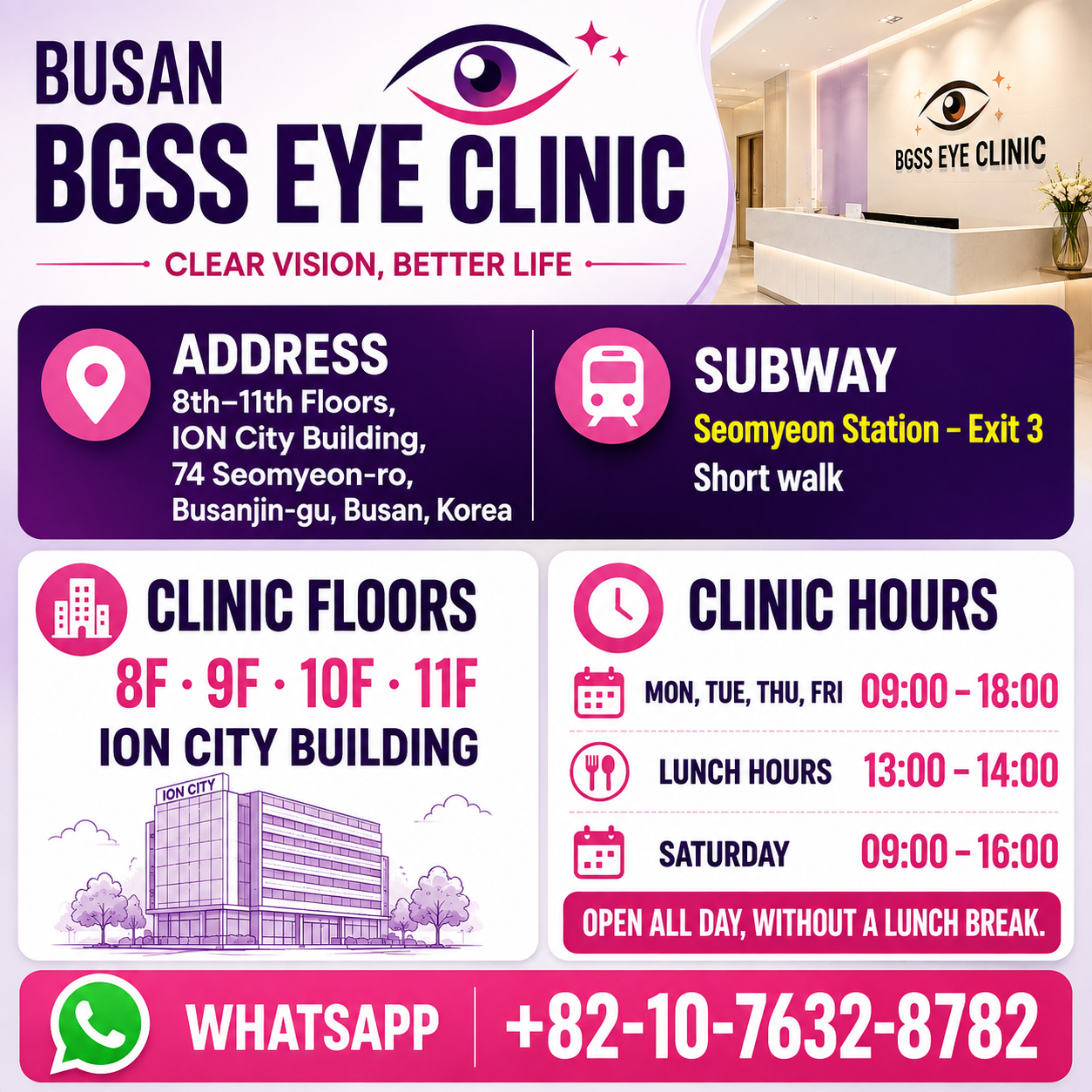
In Busan, BGSS Eye Clinic provides SMILE Pro and other vision correction procedures for both Korean and international patients, with English-speaking support available for foreign patients.
Can Foreign Residents in Korea Have SMILE Pro?
Yes. Expats who live and work in Korea can consult an ophthalmologist for SMILE Pro just like other patients.
Nationality Is Not the Main Eligibility Factor
Your eligibility is primarily determined by your eye health and whether your eyes meet the requirements for refractive surgery.
A typical evaluation considers:
- Age
- Prescription stability
- Degree of myopia
- Astigmatism
- Corneal thickness
- Corneal shape
- Dry-eye condition
- Retinal health
- Overall eye health
BGSS Eye Clinic lists stable prescriptions, treatable myopia or astigmatism, age over 18, and healthy corneas among the general considerations for SMILE Pro candidacy.
You Do Not Need to Be a Korean Citizen
Living in Korea as a foreign resident does not itself prevent you from seeking elective vision correction.
The clinic will assess your medical suitability rather than making the decision based simply on nationality.
What Is SMILE Pro?
SMILE Pro is an advanced form of laser vision correction designed primarily to correct myopia and astigmatism.
How Does SMILE Pro Work?
The procedure uses a femtosecond laser to create a small lenticule inside the cornea. The surgeon then removes the lenticule through a small incision.
Unlike conventional LASIK, SMILE Pro does not require the creation of a large corneal flap.
Why Do Expats Consider SMILE Pro?
Patients may consider SMILE Pro because it can offer:
- A small corneal incision
- No traditional LASIK flap
- A relatively quick laser treatment
- Rapid early visual recovery for many suitable patients
- Reduced dependence on glasses or contact lenses
However, SMILE Pro is not automatically better than LASIK or LASEK. The most appropriate procedure depends on your individual eye measurements and medical history.
How Do Expats Know If They Are Good Candidates?
The only reliable way to determine suitability is through a detailed eye examination.
Prescription Stability
Your prescription should generally be stable before refractive surgery.
If your prescription has changed significantly recently, your ophthalmologist may recommend waiting until your vision becomes more stable.
Healthy Corneas
Corneal thickness and shape are important considerations.
Advanced diagnostic testing can help identify whether the cornea is suitable for laser vision correction.
Overall Eye Health
Conditions affecting the cornea, retina, tear film, or other parts of the eye may influence whether SMILE Pro is appropriate.
BGSS Eye Clinic's comprehensive examination can include corneal topography, corneal thickness measurement, pupil analysis, dry-eye evaluation, retinal examination, refraction, and intraocular-pressure assessment.
What Happens During a SMILE Pro Consultation in Busan?
Your first appointment should involve more than a simple vision test.
Medical History
Tell the ophthalmologist about:
- Previous eye surgery
- Contact-lens use
- Previous eye injuries
- Eye diseases
- Current medications
- Previous prescriptions
- Dry-eye symptoms
If you have recent examination records from another country, bring them if possible.
Vision Testing
Your prescription will be measured to determine the degree of myopia and astigmatism.
The clinic may perform multiple measurements to ensure the results are consistent.
Corneal Testing
Corneal mapping and thickness measurements help the surgeon assess the shape and structural characteristics of your cornea.
This information is essential when deciding whether laser vision correction is appropriate.
Do Expats Need to Speak Korean?
No. However, communication is an important consideration when choosing a clinic.
English Support Can Make Treatment Easier
Understanding your diagnosis and postoperative instructions is particularly important after eye surgery.
BGSS Eye Clinic states that it provides foreigner-friendly care and English-speaking support for international patients.
Ask About Your Preferred Language
If English is your preferred language, confirm language support when booking your appointment.
Some clinics may also provide support in additional languages.
Where Can Expats Get SMILE Pro in Busan?
Busan has several ophthalmology centers offering refractive surgery.
Seomyeon Is a Major Option
Seomyeon is a convenient area for eye care because it is centrally located and well connected by public transportation.
BGSS Eye Clinic's Busan location is in the Seomyeon area and offers SMILE Pro, LASIK, LASEK, and ICL consultations for local and international patients.
Other Busan Eye Clinics
Other ophthalmology providers in Busan also offer vision correction procedures. For example, the Korea Tourism Organization lists BGN Eye Hospital in Busan as offering SMILE Pro, SMILE, LASIK, LASEK, and intraocular lens procedures.
This means expats have several options and do not necessarily need to travel to Seoul for refractive surgery.
How Much Does SMILE Pro Cost for Expats in Busan?
The cost can vary depending on the clinic, technology, examination findings, and treatment plan.
Why Prices Differ
Factors can include:
- Type of laser technology
- Diagnostic testing
- Surgeon and clinic
- Degree of refractive error
- Additional treatment requirements
- Follow-up care
- Promotional packages
A clinic should provide a personalized price after evaluating your eyes rather than relying solely on an advertised starting price.
Does Being an Expat Change the Price?
Not necessarily.
Your nationality or resident status does not automatically determine the medical suitability or basic treatment price. However, insurance coverage and payment arrangements can differ between patients.
Does Korean National Health Insurance Cover SMILE Pro?
Generally, elective refractive surgery such as SMILE Pro should not be assumed to be covered by National Health Insurance.
Check Your Insurance Separately
Foreign residents who are enrolled in Korea's National Health Insurance system should distinguish between covered medical care and elective vision-correction procedures.
The National Health Insurance Service provides separate guidance on health-insurance eligibility for foreign residents and overseas Koreans.
If you have private international or employer-sponsored insurance, check whether it provides any benefit for refractive surgery.
Can Expats Get SMILE Pro Without Korean Health Insurance?
The absence of Korean National Health Insurance does not necessarily prevent you from receiving elective eye surgery.
Self-Pay Treatment May Be Available
Many international patients arrange vision correction as a self-pay medical service.
The clinic can explain the examination, treatment, payment, and follow-up arrangements before surgery.
Ask About Payment Before Your Appointment
Before scheduling surgery, confirm:
- Consultation fees
- Examination fees
- Surgery price
- Accepted payment methods
- Follow-up costs
- What is included in the quoted price
This avoids unexpected expenses.
How Long Does SMILE Pro Recovery Take?
SMILE Pro is associated with relatively rapid early visual recovery, but recovery is different for every patient.
Immediately After Surgery
Your vision may initially be blurry or fluctuate.
You may also experience temporary:
- Dryness
- Grittiness
- Watering
- Light sensitivity
- Eye fatigue
Your clinic will provide postoperative instructions and medication.
Over the Following Days
Many patients experience significant improvement within the first few days, while visual stabilization can continue for longer.
BGSS Eye Clinic notes that recovery varies between individuals and that many patients experience improved vision within several days.
Can You Work After SMILE Pro?
This depends on your job and individual recovery.
Office Workers
People working on computers may be able to return relatively quickly, but temporary dryness and visual fatigue can make prolonged screen use uncomfortable.
Take regular breaks and follow your ophthalmologist's advice regarding screen use.
Physically Demanding Jobs
If your job involves dust, chemicals, heavy physical activity, or a risk of eye injury, you may need additional recovery time.
Ask your surgeon when it is appropriate to return to your specific occupation.
What Should Expats Do Before SMILE Pro?
Good preparation can make the process easier.
Before Your Examination
Prepare:
- Current glasses prescription
- Contact-lens information
- Previous eye examination records
- Medical history
- Medication information
- Details of previous eye surgery
If You Wear Contact Lenses
Ask the clinic when you should stop wearing them before the examination.
Contact lenses can temporarily affect corneal measurements, so your clinic may require a lens-free period before testing.
What Should Expats Expect on Surgery Day?
SMILE Pro itself is relatively quick, but the complete appointment takes longer than the laser treatment.
Before the Procedure
You will typically undergo final checks and preparation before surgery.
The surgeon confirms that the planned treatment remains appropriate.
During SMILE Pro
The laser creates the corneal lenticule, which is removed through a small incision.
After Surgery
You will receive postoperative instructions and eye drops.
Arrange transportation home or to your accommodation if your clinic recommends that you do not travel alone immediately after surgery.
What Are the Risks of SMILE Pro?
SMILE Pro is not risk-free.
Possible Temporary Effects
Patients may experience:
- Dry eye symptoms
- Fluctuating vision
- Glare
- Halos
- Light sensitivity
- Temporary visual disturbances
Less Common Complications
As with other refractive procedures, complications can occur.
Your ophthalmologist should discuss the potential risks and benefits based on your individual eyes before you consent to surgery.
The goal should be informed decision-making rather than assuming that a newer procedure is automatically risk-free.
When Might SMILE Pro Not Be Recommended?
Not everyone is a suitable candidate.
Potential Reasons for Choosing Another Procedure
Your ophthalmologist may recommend LASIK, LASEK, EVO ICL, or continued use of glasses or contact lenses if SMILE Pro is not appropriate.
Possible factors include:
- Unstable prescription
- Corneal abnormalities
- Insufficient corneal thickness
- Significant dry eye
- Certain eye diseases
- Prescription outside the clinic's treatable range
BGSS Eye Clinic specifically notes that unsuitable corneal thickness, unstable prescriptions, severe dry eye, irregular corneal shape, and certain eye conditions may make SMILE less suitable.
SMILE Pro vs LASIK for Expats
Both procedures can provide effective vision correction for appropriate candidates.
SMILE Pro
SMILE Pro may be attractive if you prefer a flapless procedure with a small corneal incision.
LASIK
LASIK has a long history of use and can treat a broad range of refractive errors.
Which Is Better?
There is no universal winner.
Your ophthalmologist should compare the procedures based on your:
- Corneal anatomy
- Prescription
- Dry-eye status
- Lifestyle
- Occupational needs
- Personal preferences
SMILE Pro vs LASEK for Expats
LASEK may be considered when certain corneal characteristics make other laser procedures less suitable.
Recovery Is Different
LASEK generally involves a more noticeable early recovery period than SMILE Pro.
For an expat who needs to return to work quickly, recovery expectations may be an important part of the discussion.
However, medical suitability should always come before convenience.
SMILE Pro vs EVO ICL
EVO ICL is different from laser vision correction because it involves placing an implantable lens inside the eye.
When Might ICL Be Considered?
It may be considered for some patients with higher prescriptions, thinner corneas, or other characteristics that make corneal laser surgery less suitable.
BGSS Eye Clinic offers both SMILE Pro and EVO ICL and evaluates patients to determine which option is appropriate.
Can Expats Have SMILE Pro Without Traveling to Seoul?
Yes.
Why Choose Busan?
For expats already living in Busan, having surgery locally can simplify:
- Consultation
- Preoperative testing
- Surgery
- Follow-up appointments
- Communication with the clinic
- Recovery at home
You do not necessarily need to travel to Seoul simply because you are a foreign resident.
What Are the Advantages of Having Surgery While Living in Busan?
Living locally provides several practical benefits.
You Can Attend Follow-Up Appointments
If your ophthalmologist wants to examine your eyes again, you are already nearby.
No International Travel During Early Recovery
You do not have to arrange flights, hotels, or airport transportation immediately after surgery.
Easier Long-Term Follow-Up
If you develop dry-eye symptoms or have questions about your recovery, returning to the same clinic can be easier when you live locally.
What Should Expats Ask Before Booking SMILE Pro?
Before scheduling the procedure, ask:
- Do you provide consultations in English?
- What tests are included in the preoperative examination?
- How long should I stop wearing contact lenses?
- Am I likely to be suitable for SMILE Pro?
- What alternatives are available if I am not a candidate?
- How many follow-up appointments are recommended?
- What is included in the treatment price?
- What should I avoid after surgery?
- When can I return to work?
- Who should I contact if I experience unexpected symptoms?
A Practical SMILE Pro Plan for Busan Expats
If you live in Busan, you can keep the process relatively straightforward.
Step 1: Book a Consultation
Choose a clinic that provides the language support and diagnostic testing you need.
Step 2: Complete the Eye Examination
Your eyes should be thoroughly evaluated before deciding on surgery.
Step 3: Discuss Your Options
Ask whether SMILE Pro, LASIK, LASEK, or ICL best fits your eye condition.
Step 4: Schedule Surgery
If you are a suitable candidate, arrange the procedure at a time that allows sufficient recovery before returning to work.
Step 5: Attend Follow-Up
Do not skip postoperative examinations simply because your vision feels good.
Early follow-up helps your ophthalmologist monitor healing.
Conclusion
Expats living in Busan can get SMILE Pro surgery in Korea if they meet the medical requirements for the procedure. Your nationality or foreign-resident status does not automatically prevent you from receiving laser vision correction.
The most important step is a comprehensive eye examination. Your ophthalmologist needs to evaluate your prescription, corneal thickness and shape, tear film, retinal health, and overall suitability before recommending SMILE Pro.
For expats already living in Busan, having surgery locally can be especially convenient. You can complete your consultation, surgery, and follow-up without arranging international travel during recovery.
If SMILE Pro is not the right option for your eyes, alternatives such as LASIK, LASEK, or EVO ICL may be considered.
Ultimately, the best vision-correction procedure is not the one that is most popular. It is the one that your ophthalmologist determines is appropriate for your eyes, prescription, lifestyle, and long-term visual goals.
Frequently Asked Questions
Can foreigners living in Busan get SMILE Pro surgery?
Yes. Foreign residents can receive SMILE Pro consultation and surgery in Busan if they meet the medical criteria for the procedure. BGSS Eye Clinic provides vision correction services for international patients.
Do I need Korean citizenship to get SMILE Pro in Busan?
No. Citizenship is not the primary factor in determining whether you are medically suitable for SMILE Pro. A comprehensive eye examination is required before treatment.
Can expats get SMILE Pro without Korean National Health Insurance?
Elective vision correction can generally be arranged as self-pay treatment, but you should confirm payment and insurance details with the clinic. Korean National Health Insurance eligibility for foreign residents is handled separately by the National Health Insurance Service.
Is English support available for SMILE Pro in Busan?
Yes. BGSS Eye Clinic states that it provides English-speaking support and foreigner-friendly ophthalmology services in Busan.
How do I know if I qualify for SMILE Pro?
You need a detailed eye examination. Your ophthalmologist will evaluate prescription stability, corneal thickness, corneal shape, dry eye, retinal health, and other factors before making a recommendation.
Can I work soon after SMILE Pro in Busan?
Many patients experience improved vision within several days, but recovery varies. Your return-to-work timing depends on your occupation, symptoms, and your ophthalmologist's advice.
What if I am not suitable for SMILE Pro?
Your ophthalmologist may discuss alternatives such as LASIK, LASEK, EVO ICL, or continued use of glasses or contact lenses, depending on your eye condition.
Do expats need to travel to Seoul for SMILE Pro?
No. Busan has ophthalmology clinics offering SMILE Pro and other vision correction procedures. Expats living in Busan can seek consultation and treatment locally.
How many follow-up visits are needed after SMILE Pro?
The schedule varies by clinic and patient. Your ophthalmologist will provide a postoperative follow-up plan based on your recovery and eye condition.
Is SMILE Pro better than LASIK for expats?
Neither procedure is universally better. The appropriate choice depends on your corneal anatomy, prescription, dry-eye status, lifestyle, and other clinical factors.