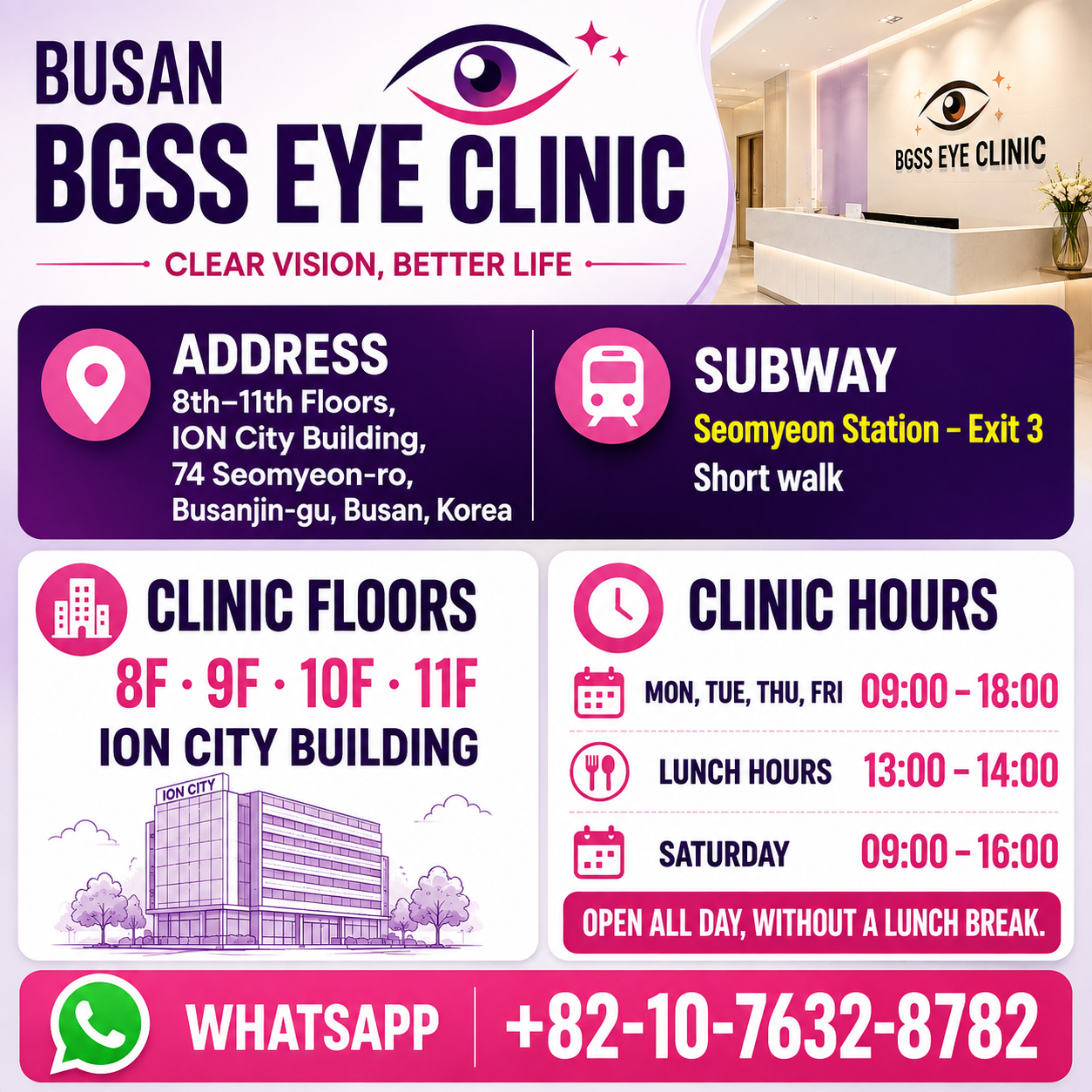
Best Eye Clinics Near Seomyeon Station in Busan, Korea
Introduction
For patients looking for eye care in Busan, choosing a clinic near Seomyeon Station can make the entire experience more convenient.
Seomyeon is one of Busan's major transportation and commercial districts, making it a practical location for people seeking eye examinations, vision correction consultations, LASIK, LASEK, SMILE, SMILE Pro, ICL, cataract evaluation, and other ophthalmology services.
For international patients, proximity to a major subway station can be especially helpful. You may need to visit the clinic more than once for diagnostic testing, surgery, and postoperative examinations.
However, the "best" eye clinic is not necessarily the one closest to Seomyeon Station.
A better approach is to compare ophthalmologist experience, diagnostic testing, available procedures, patient selection, postoperative care, communication, and overall transparency.
This guide explains how to evaluate eye clinics near Seomyeon Station and what international patients should consider before choosing a provider.
Why Choose an Eye Clinic Near Seomyeon Station?
Convenient Transportation
Seomyeon Station is a major transportation point in Busan.
Choosing a clinic within convenient reach of the station can make it easier to attend:
- Initial consultations
- Diagnostic examinations
- Preoperative testing
- Surgery
- Postoperative appointments
- Follow-up visits
This can be particularly useful for patients who are unfamiliar with Busan.
Why Location Matters After Eye Surgery
Reduce Unnecessary Travel
After vision-correction surgery, some patients experience temporary:
- Blurred vision
- Light sensitivity
- Watery eyes
- Glare
- Visual fluctuations
Long journeys immediately after treatment may be uncomfortable.
A clinic near your hotel or a major transportation hub can make the recovery period more manageable.
You should still follow your surgeon's specific instructions about transportation after surgery.
What Types of Eye Clinics Are Near Seomyeon?
Different Clinics Serve Different Needs
Patients may find providers offering:
- General ophthalmology
- Comprehensive eye examinations
- LASIK
- LASEK
- PRK
- SMILE
- SMILE Pro
- ICL
- Toric ICL
- Cataract surgery
- Dry-eye treatment
- Retina evaluation
- Glaucoma evaluation
- Pediatric eye care
Not every clinic offers all of these services.
Before booking, confirm that the clinic provides the specific examination or procedure you need.
What Makes an Eye Clinic a Good Choice?
Look Beyond Location
When evaluating an eye clinic near Seomyeon Station, consider:
- Ophthalmologist qualifications
- Experience with the procedure you need
- Comprehensive diagnostic testing
- Modern imaging equipment
- Clear explanation of treatment options
- Patient-selection standards
- Postoperative monitoring
- Emergency arrangements
- Transparent pricing
- International patient communication
A convenient location is valuable, but medical quality should come first.
Eye Exams Near Seomyeon Station
Start With a Comprehensive Examination
If you are unsure which procedure you need, begin with an eye examination rather than booking a specific surgery.
Depending on your symptoms and medical history, testing may include:
- Visual acuity
- Refraction
- Eye pressure
- Slit-lamp examination
- Corneal topography
- Corneal tomography
- Corneal thickness measurement
- Tear-film evaluation
- Retinal examination
- OCT
- Pupil measurement
The exact tests should be determined by an ophthalmologist.
Eye Clinics for LASIK Near Seomyeon
What to Check Before Laser Vision Correction
LASIK is widely available internationally, but patient suitability varies.
Before LASIK, ask whether the clinic evaluates:
- Corneal thickness
- Corneal shape
- Corneal topography
- Corneal tomography
- Prescription stability
- Dry-eye status
- Pupil size
- Overall ocular health
A glasses prescription alone is not enough to determine whether LASIK is appropriate.
SMILE and SMILE Pro Near Seomyeon
Compare Candidacy Before Choosing Technology
Patients may be interested in SMILE or SMILE Pro because these procedures use a small corneal incision rather than creating a traditional LASIK flap.
However, the technology is not suitable for every patient.
Ask the clinic:
- Am I a suitable candidate?
- How much myopia and astigmatism can be treated?
- What does my corneal imaging show?
- Which technology will be used?
- Why is this procedure recommended instead of LASIK or LASEK?
- What happens if residual refractive error remains?
A good clinic should explain the reasoning behind its recommendation.
ICL Clinics Near Seomyeon Station
A Different Approach to Vision Correction
ICL is an implantable lens procedure.
Unlike laser eye surgery, ICL does not intentionally reshape the cornea.
It may be considered for selected patients with moderate to high myopia or patients who are not ideal candidates for certain corneal laser procedures.
Before ICL, the clinic may evaluate:
- Anterior chamber depth
- Endothelial cell density
- Corneal health
- Anterior-segment anatomy
- Prescription stability
- Retinal health
- Eye pressure
Patients should ask which lens model is recommended and why.
Toric ICL for Astigmatism
Ask About Lens Alignment
Patients with myopia and astigmatism may be evaluated for Toric ICL.
Because the lens contains astigmatism correction with a specific axis, accurate measurements and appropriate positioning are important.
Ask:
- How is the axis determined?
- How is the lens aligned?
- How is rotation monitored?
- What happens if the lens rotates?
- How many follow-up visits are required?
Cataract Clinics Near Seomyeon
Vision Changes After Middle Age
Patients over 40 or 50 may notice:
- Increasing difficulty reading
- Glare around lights
- Reduced night vision
- Cloudy or hazy vision
- Frequent prescription changes
These symptoms can have several causes, including presbyopia and cataracts.
An ophthalmologist can determine whether cataract evaluation is appropriate.
For cataract patients, lens selection should be based on eye health, visual goals, lifestyle, and medical considerations—not simply the newest lens technology.
Retina and OCT Services
When Detailed Retinal Evaluation May Be Needed
Some clinics may offer retinal imaging such as OCT or fundus photography.
These tests can be useful when evaluating selected patients with:
- High myopia
- Diabetes
- Macular symptoms
- Retinal disease
- Glaucoma risk
- Unexplained visual changes
Retinal imaging does not replace a comprehensive eye examination.
Dry-Eye Evaluation Near Seomyeon
Important Before Refractive Surgery
Dry eye is particularly relevant for patients considering laser vision correction.
A clinic may evaluate:
- Tear-film stability
- Meibomian gland function
- Corneal surface
- Existing dry-eye symptoms
- Contact lens history
If significant ocular-surface problems are present, treatment may be recommended before refractive surgery.
How to Compare Eye Clinics Near Seomyeon Station
A Simple Evaluation Framework
Instead of choosing a clinic based only on online rankings, compare these six areas:
1. Medical expertise
Who will perform your examination and surgery?
2. Diagnostic testing
Are the necessary tests performed before treatment?
3. Procedure selection
Does the clinic compare multiple suitable options?
4. Safety and follow-up
What postoperative monitoring is provided?
5. Communication
Can the medical team explain your treatment clearly?
6. Total cost
What exactly is included in the quoted price?
This approach can help you make a more informed decision.
How Important Are Online Reviews?
Use Reviews as One Source, Not the Final Decision
Online reviews can help you understand patient experiences with:
- Communication
- Waiting times
- Clinic environment
- International patient services
- General satisfaction
However, reviews cannot determine whether a procedure is medically appropriate for your eyes.
A patient with a different prescription, corneal structure, or medical history may have a completely different treatment experience.
Questions to Ask Before Booking
Medical Questions
Ask:
- Which procedure is appropriate for me?
- Why do you recommend it?
- What alternatives do I have?
- Is my cornea suitable for laser surgery?
- Do I have dry eye?
- Is my prescription stable?
- Do I need retinal imaging?
- What are my individual risks?
Clinic Questions
Also ask:
- Who will perform the surgery?
- How experienced are they with this procedure?
- What diagnostic equipment is used?
- How many follow-up visits are included?
- What happens if I need additional treatment?
- Is emergency care available?
- Can I receive my medical records?
Questions for International Patients
Confirm Language Support
If you are visiting Busan from another country, ask whether the clinic offers:
- English consultation
- Medical interpretation
- English written instructions
- International patient coordination
- Postoperative communication
- Medical records in English
Do not assume that every clinic near Seomyeon Station provides the same level of international support.
How Much Does Eye Surgery Near Seomyeon Cost?
Prices Vary
There is no single standard price for eye surgery in Seomyeon.
The total cost may depend on:
- Procedure
- Laser or lens technology
- Diagnostic testing
- Surgeon
- Prescription
- Complexity of treatment
- Medication
- Follow-up care
- International patient services
When comparing prices, ask for an itemized quotation.
A low advertised price may not include all required examinations or postoperative care.
What Should International Patients Bring?
Prepare Your Eye Records
Bring:
- Current glasses prescription
- Contact lens prescription
- Previous eye examination reports
- Previous surgical records
- Medication list
- Previous corneal imaging
- Relevant medical information
If you have worn contact lenses for a long time, ask the clinic when you should stop wearing them before your examination.
How Long Should You Stay Near Seomyeon?
Plan Around Follow-Up, Not Just Surgery
International patients should not plan their Busan trip around the surgery date alone.
Depending on the procedure, you may need:
- Consultation
- Diagnostic testing
- Surgery
- Early postoperative examination
- Additional follow-up
Ask the clinic how many visits are required before returning home.
Where to Stay Near Seomyeon Station
Choose Accommodation for Recovery
If you are traveling for eye surgery, consider accommodation that is:
- Close to the clinic
- Easy to reach
- Quiet
- Comfortable
- Convenient for meals
- Close to pharmacies or basic services
You may not need a luxury hotel.
Convenience can be more useful during early recovery.
Can You Sightsee in Busan After Eye Surgery?
Recovery Should Come First
Busan offers attractions such as Haeundae, Gwangalli, Gamcheon Culture Village, and Nampo-dong.
However, immediately after eye surgery, extensive sightseeing may not be appropriate.
Your surgeon may advise temporary restrictions on:
- Swimming
- Heavy exercise
- Dusty environments
- Certain outdoor activities
- Prolonged exposure to bright sunlight
Follow your clinic's instructions rather than assuming that a particular activity is safe because you feel well.
What If You Need Care After Returning Home?
Plan Before Leaving Korea
International patients should ask the clinic:
- How can I contact you after returning home?
- Can I receive my surgical records?
- What symptoms require urgent attention?
- Can my local ophthalmologist communicate with your clinic?
- What happens if I need an enhancement or additional treatment?
Having a clear plan can make international medical care safer and less stressful.
Warning Signs When Choosing an Eye Clinic
Be Cautious With Aggressive Marketing
Think carefully if a clinic:
- Guarantees perfect vision
- Promises zero complications
- Recommends surgery without adequate testing
- Pressures you to book immediately
- Focuses only on discounts
- Avoids discussing alternatives
- Cannot explain postoperative care
- Gives unclear pricing
These are concerns that can apply to clinics anywhere in the world.
Is the Closest Clinic the Best Clinic?
Not Necessarily
A clinic five minutes from Seomyeon Station may be less suitable for you than a clinic farther away with:
- More appropriate diagnostic testing
- Greater experience with your procedure
- Better follow-up arrangements
- More suitable technology
- Stronger communication
Location should be considered alongside medical quality.
Best Way to Find the Right Eye Clinic Near Seomyeon
Use a Step-by-Step Approach
Step 1: Determine what type of eye care you need.
Step 2: Shortlist clinics that offer the relevant service.
Step 3: Check the ophthalmologist's qualifications and procedure experience.
Step 4: Ask about preoperative diagnostic testing.
Step 5: Compare treatment options rather than focusing on one procedure.
Step 6: Request a complete cost estimate.
Step 7: Confirm postoperative follow-up.
Step 8: If you are an international patient, confirm language and travel support.
This approach is more reliable than simply searching for the clinic with the highest online rating.
Conclusion
Seomyeon Station is a convenient location for patients seeking eye care in Busan because of its central position, transportation connections, and access to accommodation and everyday services.
Patients may find clinics offering comprehensive eye examinations, LASIK, LASEK, PRK, SMILE, SMILE Pro, ICL, cataract evaluation, retinal imaging, and dry-eye care.
However, the best eye clinic for you is not necessarily the closest one.
For vision correction, the most important factors are appropriate patient selection, comprehensive diagnostic testing, surgeon experience, procedure suitability, postoperative care, and clear communication.
For international patients, these considerations become even more important because treatment involves travel and potentially follow-up after returning home.
Use Seomyeon's convenient location as an advantage—but choose your eye clinic based on medical quality and suitability rather than location, discounts, or marketing claims alone.
FAQs About Eye Clinics Near Seomyeon Station
1. Are there eye clinics near Seomyeon Station in Busan?
Yes. Seomyeon is a major medical and commercial district in Busan, and patients can find ophthalmology services in and around the area.
2. Can I get LASIK near Seomyeon Station?
Selected ophthalmology clinics offer laser vision correction, but availability varies. Patients should confirm the procedure and undergo appropriate diagnostic testing before treatment.
3. Is SMILE Pro available near Seomyeon?
SMILE Pro is available at selected providers. Whether it is appropriate depends on your prescription, corneal anatomy, and overall eye health.
4. Can foreigners visit eye clinics near Seomyeon?
International patients can seek eye care in Busan, but language services and international patient support vary by clinic.
5. How do I choose the best eye clinic near Seomyeon Station?
Compare ophthalmologist experience, diagnostic testing, procedure options, postoperative care, communication, pricing, and emergency arrangements.
6. How much does LASIK cost near Seomyeon?
Prices vary by clinic and procedure. Request an itemized quotation that includes examinations, surgery, medications, and follow-up.
7. Should I stay near Seomyeon after eye surgery?
Staying near your clinic can be convenient during early recovery, especially if several follow-up appointments are required.
8. Can I travel around Busan after eye surgery?
You should follow your surgeon's activity restrictions. Sightseeing may need to be limited during the early recovery period.
9. Do eye clinics near Seomyeon perform ICL?
Selected clinics may offer ICL. Candidates require specialized anatomical testing before implantation.
10. Is location the most important factor when choosing an eye clinic?
No. Location is useful for convenience, but medical expertise, diagnostic quality, procedure suitability, and postoperative care are more important.