Eye Checkups for International School Students in Korea
Introduction
International school students in Korea often have busy academic schedules, long periods of reading, computer use, homework, and extracurricular activities. All of these can make good vision especially important for learning and daily life.
An eye checkup for international school students in Korea can help identify common childhood and teenage vision problems such as myopia, astigmatism, hyperopia, amblyopia, and eye alignment problems. Regular examinations can also be useful for students who already wear glasses or contact lenses.
For international families living in Korea, eye care can sometimes feel unfamiliar, particularly when children have previously received care in another country. Understanding what a pediatric eye examination involves, when students should be checked, and what records to bring can make the process easier.
This guide explains what parents should know about eye checkups for children and teenagers attending international schools in Korea, including students in Seoul, Busan, and other Korean cities.
Why Eye Health Matters for International School Students
Clear Vision Supports Learning
Students rely on their vision throughout the school day.
They may need to:
- Read textbooks
- See classroom boards
- Use computers
- Read presentations
- Write notes
- Participate in laboratory activities
- Play sports
- Navigate unfamiliar environments
Even a relatively small reduction in visual clarity can make certain tasks more tiring.
Children May Not Realize Their Vision Is Blurry
A child who has gradually developed myopia may assume that everyone sees distant objects the same way.
They may not complain about blurry vision because they have adapted to it.
This is one reason routine eye examinations are useful even when a student appears to see normally.
Common Eye Problems in School-Age Children
Myopia
Myopia is one of the most common vision problems affecting school-age children and teenagers.
A myopic student may have difficulty seeing:
- Classroom boards
- Projectors
- Signs
- Faces at a distance
- Sports activities
Possible behavioral signs include sitting close to screens or moving closer to the board.
Because childhood myopia can progress, regular monitoring is important.
Astigmatism
Astigmatism can cause blurred or distorted vision.
Students may experience:
- Difficulty seeing small print
- Visual fatigue
- Headaches
- Squinting
- Difficulty concentrating during prolonged reading
Significant astigmatism can often be corrected with prescription glasses or contact lenses.
Hyperopia
Some degree of farsightedness is common in children.
However, significant hyperopia can sometimes contribute to focusing difficulty, eye strain, or blurred near vision.
An eye examination can determine whether treatment is necessary.
Amblyopia
Amblyopia, commonly called lazy eye, occurs when normal visual development does not occur in one or both eyes.
It may be associated with:
- Unequal prescriptions
- Strabismus
- Significant refractive errors
- Conditions that interfere with clear vision during early childhood
Because children may rely on their stronger eye, amblyopia can remain unnoticed without individual eye testing.
Strabismus
Strabismus occurs when the eyes are not properly aligned.
One eye may turn inward, outward, upward, or downward.
Some children have obvious eye misalignment, while others have more subtle forms.
Early assessment can help determine whether monitoring or treatment is appropriate.
When Should International School Students Have Eye Checkups?
Routine Examinations
The appropriate frequency depends on the child's age, eye health, family history, prescription, and previous findings.
Children with known eye conditions may need more frequent follow-up.
Students who wear glasses or contact lenses should also follow the schedule recommended by their eye-care professional.
Before Starting an International School
An eye examination can be particularly useful when a child is:
- Starting a new school
- Moving to Korea
- Transferring between international schools
- Beginning a new academic year
- Starting intensive computer-based learning
This can establish a useful baseline for future comparisons.
Signs Your Child May Need an Eye Examination
Changes in Classroom Behavior
Parents and teachers may notice:
- Squinting at the board
- Sitting unusually close to screens
- Holding books very close
- Difficulty copying from the board
- Frequent eye rubbing
- Avoiding reading
- Complaints of headaches
- Losing their place while reading
These signs do not automatically mean that the child has an eye disorder, but they are reasonable reasons to arrange an assessment.
Closing One Eye
A child who frequently closes one eye—particularly outdoors or while looking at distant objects—may benefit from an eye examination.
This behavior can sometimes occur with refractive errors, eye alignment problems, or light sensitivity.
What Happens During an Eye Checkup in Korea?
Medical and Vision History
The eye doctor may ask about:
- Previous eye examinations
- Glasses
- Contact lenses
- Myopia progression
- Family history
- Previous eye treatment
- Eye injuries
- Headaches
- Screen use
- School-related visual difficulties
International families should bring previous records whenever possible.
Visual Acuity Testing
The doctor checks how clearly the child sees at different distances.
Each eye may be tested separately.
Age-appropriate charts or symbols can be used for younger children.
Refraction Testing
Refraction determines whether the student has:
- Myopia
- Hyperopia
- Astigmatism
- Unequal prescriptions between the eyes
If the student already wears glasses, the doctor can compare the new measurement with the previous prescription.
Why Children May Need Cycloplegic Refraction
Children Can Focus Strongly
Children and teenagers have strong focusing ability.
This can sometimes affect the accuracy of a standard prescription measurement.
Cycloplegic eye drops temporarily relax the focusing muscles, allowing the ophthalmologist to measure refractive error more accurately.
This may be especially useful when:
- A child is young
- Hyperopia is suspected
- Myopia measurements are inconsistent
- The prescription has changed unexpectedly
- The doctor needs a more precise assessment
What Happens After the Drops?
The pupils may remain enlarged temporarily.
The child may also experience:
- Increased sensitivity to light
- Temporary difficulty focusing on near objects
These effects generally wear off as the drops stop working.
Parents should follow the clinic's instructions following the examination.
Eye Health Examination
Checking More Than Vision
A comprehensive eye examination may also assess the health of the:
- Cornea
- Conjunctiva
- Lens
- Retina
- Optic nerve
- Other visible eye structures
The exact tests depend on the student's age, symptoms, medical history, and clinical findings.
Myopia Management for International School Students
Why Myopia Monitoring Matters
Children and teenagers can experience changes in their prescription as they grow.
International school students may spend significant time on near-focused activities, including:
- Reading
- Homework
- Tablets
- Computers
- Smartphones
Near work is only one factor associated with myopia; genetics, age, and outdoor exposure also play important roles.
What Is Myopia Management?
If a student's myopia is progressing, the eye doctor may discuss options designed to slow progression.
Depending on the child's individual situation, these may include:
- Specialized spectacle lenses
- Myopia-control contact lenses
- Orthokeratology
- Low-dose atropine
- Increased outdoor activity
Not every child needs active myopia-control treatment.
The appropriate option depends on age, prescription, progression, eye health, and other factors.
International Students and Contact Lenses
When Teenagers Wear Contacts
Older students may choose contact lenses for:
- Sports
- School activities
- Appearance
- Convenience
- Daily vision correction
Contact lenses require proper fitting and responsible hygiene.
Teenagers should understand the importance of:
- Washing hands
- Following replacement schedules
- Avoiding overnight wear unless prescribed
- Avoiding water exposure
- Not sharing lenses
- Removing lenses when significant discomfort occurs
Backup Glasses Are Important
International students who wear contact lenses should keep a pair of prescription glasses available.
Glasses can be useful when:
- A contact lens is lost
- Eyes become irritated
- Traveling
- Studying for long periods
- The eye doctor recommends a break from contact lenses
Screen Time and Student Eye Health
Digital Learning Is Common
Many international schools use laptops, tablets, projectors, and interactive displays.
Long periods of screen use can contribute to temporary symptoms such as:
- Dry eyes
- Blurred vision
- Headaches
- Eye fatigue
- Increased blinking
These symptoms do not necessarily mean permanent eye damage.
Healthy Screen Habits
Students can support visual comfort by:
- Taking regular breaks
- Looking into the distance periodically
- Blinking regularly
- Keeping screens at a comfortable distance
- Using appropriate room lighting
- Avoiding extremely bright screen settings
- Spending time outdoors
If symptoms persist, an eye examination can help identify whether another problem is contributing.
Outdoor Time and Childhood Myopia
Outdoor Activity Is Important
Regular outdoor time is associated with a lower risk of developing myopia in children.
Parents can encourage students to spend time outdoors through:
- Walking
- Cycling
- Outdoor sports
- Playing in parks
- Family activities
Outdoor time should complement—not replace—professional eye care.
Eye Exams for Students Who Play Sports
Vision Matters Beyond the Classroom
Good vision is important for:
- Football
- Basketball
- Tennis
- Badminton
- Swimming
- Martial arts
- Other sports
Students who wear glasses or contact lenses may need sport-specific advice.
Protective Eyewear
For sports involving potential eye impact, appropriate protective eyewear may be recommended.
Contact lenses do not protect the eye from injury.
Eye Checkups for Students With Headaches
When Headaches May Be Vision-Related
Some children experience headaches or visual discomfort when they have an uncorrected refractive error or focusing problem.
However, headaches have many possible causes.
Parents should not automatically assume that eye strain is responsible.
If headaches are recurrent, an appropriate medical assessment is advisable.
International Families Moving to Korea
Bring Previous Eye Records
Parents should bring copies of:
- Previous prescriptions
- Visual acuity results
- Myopia measurements
- Contact lens information
- Previous treatment records
- Eye surgery records, if applicable
- Myopia-control records
Previous measurements can help the Korean eye doctor identify changes over time.
Keep Records in Digital Form
International families may move between countries.
Keeping digital copies of eye-care records can make future appointments easier.
Important information includes the date of examination, prescription, visual acuity, and treatment recommendations.
Language Support for International Patients
Communication Matters
International families may want to confirm whether a clinic provides:
- English-speaking staff
- Interpreter support
- English medical reports
- Written prescriptions
- Digital test results
Parents should feel comfortable asking questions about their child's diagnosis and treatment.
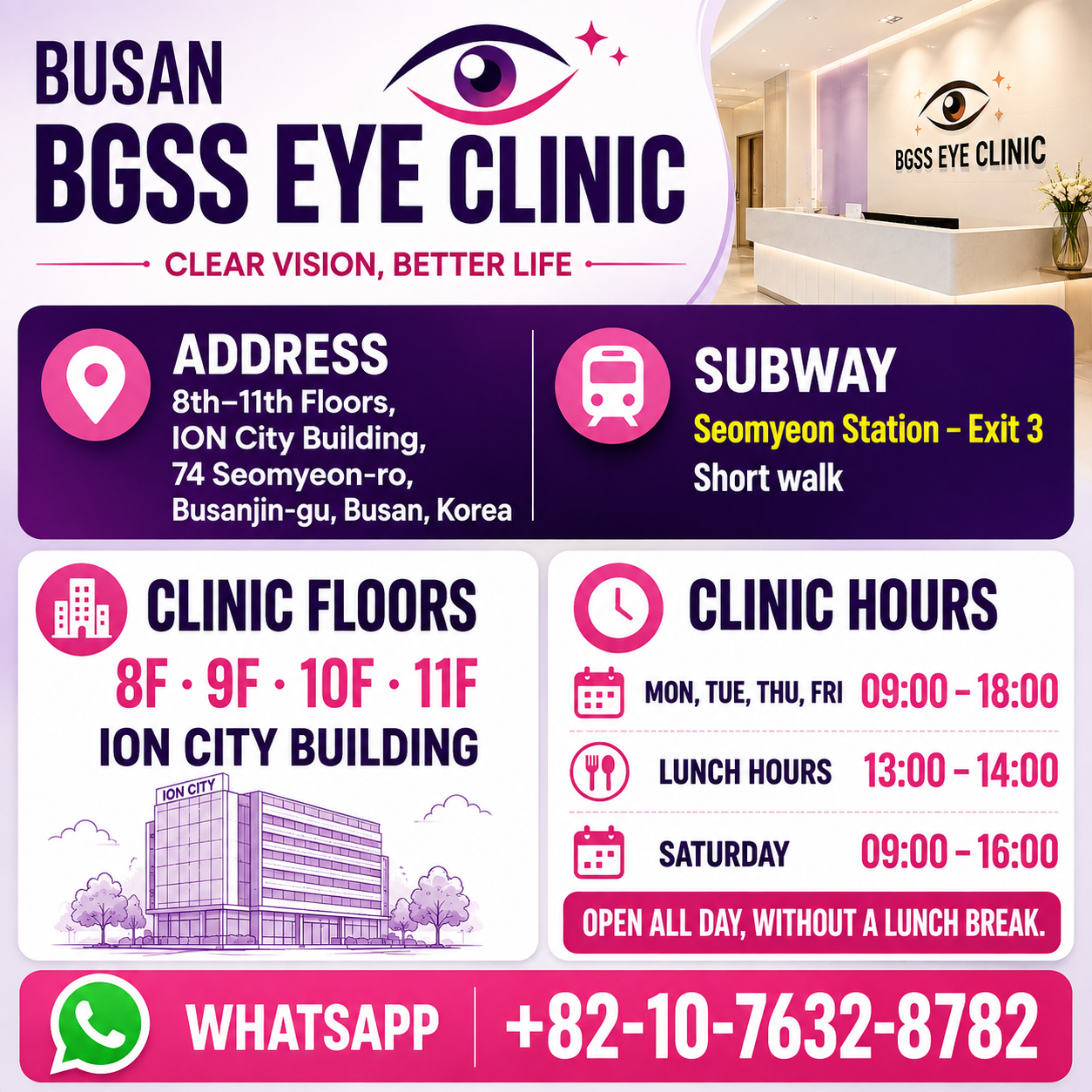
Eye Care for International School Students in Busan
Students Living in Busan
International school families in Busan can seek pediatric or general ophthalmology services for routine vision assessments, myopia monitoring, glasses prescriptions, contact lens evaluations, and other eye concerns.
Families should choose a clinic appropriate for the child's age and specific eye-care needs.
When a Child Already Has an Eye Condition
Students with conditions such as:
- Progressive myopia
- Amblyopia
- Strabismus
- Significant astigmatism
- Previous eye surgery
may require more specialized follow-up.
Parents should provide the ophthalmologist with the child's previous diagnosis and treatment history.
How Parents Can Prepare for an Eye Checkup
Before the Appointment
Parents can make the appointment easier by noting:
- Current symptoms
- Changes in school performance
- Current screen habits
- Current glasses prescription
- Contact lens use
- Previous eye conditions
- Family history of myopia or other eye diseases
Bring the Current Glasses
If the child wears glasses, bring them to the appointment.
The doctor can compare the current prescription with the new measurements and check whether the glasses remain appropriate.
Questions International Parents Can Ask
Useful Questions During the Consultation
- Does my child have normal vision in both eyes?
- Has my child's prescription changed?
- Does my child have myopia or astigmatism?
- Is my child's myopia progressing?
- Should we monitor axial length?
- Does my child need new glasses?
- Does my child need a cycloplegic refraction?
- Are there signs of amblyopia or strabismus?
- Should we consider myopia-control treatment?
- How often should my child return?
- Is contact lens wear appropriate for my teenager?
- Are there any sports or school activities that require special eye protection?
When Should Parents Seek Prompt Eye Care?
Sudden Symptoms Should Not Wait for a Routine Checkup
Parents should seek prompt professional evaluation if a student develops:
- Sudden vision loss
- Severe eye pain
- Significant eye trauma
- Sudden double vision
- A sudden new eye turn
- Severe redness with vision changes
- Significant light sensitivity accompanied by visual changes
These symptoms may require more urgent assessment.
Conclusion
Eye checkups for international school students in Korea are an important part of maintaining healthy vision during childhood and adolescence.
Students rely heavily on their eyes for reading, classroom learning, digital devices, sports, and everyday activities. Yet many children do not realize when their vision has gradually become blurry.
Regular eye examinations can identify common problems such as myopia, astigmatism, hyperopia, amblyopia, and strabismus. For students whose myopia is progressing, an eye doctor can also discuss appropriate monitoring and myopia-management strategies.
For international families, bringing previous prescriptions and examination records can make the transition to eye care in Korea easier. Parents may also want to ask about English communication, written reports, and follow-up arrangements.
Most importantly, parents should not wait until a child complains of poor vision. Changes in classroom behavior, frequent squinting, headaches, sitting close to screens, or difficulty seeing the board can all be reasons to arrange an eye examination.
Good vision supports both academic performance and everyday confidence, making regular eye care a valuable part of a child's overall health routine in Korea.
FAQs About Eye Checkups for International School Students in Korea
1. Why do international school students need regular eye exams?
Students depend on clear vision for reading, classroom learning, computers, sports, and other activities. Regular examinations can identify vision problems that children may not recognize themselves.
2. How often should an international school student have an eye exam?
The appropriate frequency depends on age, eye health, prescription, family history, and previous findings. Students with myopia or another eye condition may need more frequent monitoring.
3. What are signs that my child needs an eye checkup?
Possible signs include squinting, sitting close to screens, difficulty seeing the board, headaches, eye rubbing, avoiding reading, or complaining about blurry vision.
4. Can my child have myopia without knowing it?
Yes. Children can adapt to gradually worsening distance vision and may not realize that their vision is blurry.
5. Does screen time cause myopia?
Myopia has multiple contributing factors, including genetics, age, and environmental influences. Screen and near-work habits are relevant to children's visual behavior, but myopia should not be attributed to screen time alone.
6. What tests are included in a children's eye exam?
Depending on age and circumstances, an examination may include visual acuity, refraction, eye alignment assessment, eye-movement testing, and an examination of eye health.
7. Will my child need dilating drops?
Not every child needs dilation. Cycloplegic refraction may be recommended when the ophthalmologist needs a more accurate measurement of the child's refractive error.
8. Should students who wear glasses have regular eye exams?
Yes. Children's prescriptions can change as they grow. Regular examinations can determine whether their glasses remain appropriate.
9. Can international students get eye care in Korea?
Yes. International families can seek eye-care services in Korea. It is useful to confirm communication options and bring previous medical and eye-care records.
10. Should teenagers who wear contact lenses have eye checkups?
Yes. Contact lenses require appropriate fitting and ongoing monitoring, particularly when prescriptions or wearing habits change.
11. Can eye exams detect lazy eye?
A comprehensive examination can identify unequal vision and other findings associated with amblyopia. Testing each eye separately is particularly important.
12. When should a child see an eye doctor urgently?
Sudden vision loss, severe eye pain, significant eye injury, sudden double vision, or sudden changes in eye alignment should receive prompt professional assessment.