Busan Subway Guide for Eye Clinic Visitors in Seomyeon
Introduction
Seomyeon is one of Busan's busiest transportation and commercial areas, making it a convenient base for international patients visiting eye clinics for consultations, diagnostic testing, LASIK, SMILE Pro, ICL, or other vision-care procedures.
For visitors unfamiliar with Busan, the subway can be one of the easiest ways to reach a clinic. However, navigating public transportation can feel different when you are preparing for eye surgery or recovering from a procedure.
Bright station lighting, crowds, stairs, transfers, and temporary blurry vision can make a normal subway journey less comfortable after eye surgery.
This guide explains how international patients can use the Busan subway when visiting an eye clinic in Seomyeon, what to consider before and after surgery, and when a taxi may be a better option.
Why Is Seomyeon Convenient for Eye Clinic Visitors?
A Major Transportation Area
Seomyeon is served by Busan Metro Line 1 and Line 2, making it an important transfer point within the city.
This can make it convenient for patients traveling from other parts of Busan.
Depending on where you are staying, you may be able to reach Seomyeon without changing trains or with only one transfer.
Many Clinics Are Within the Broader Seomyeon Area
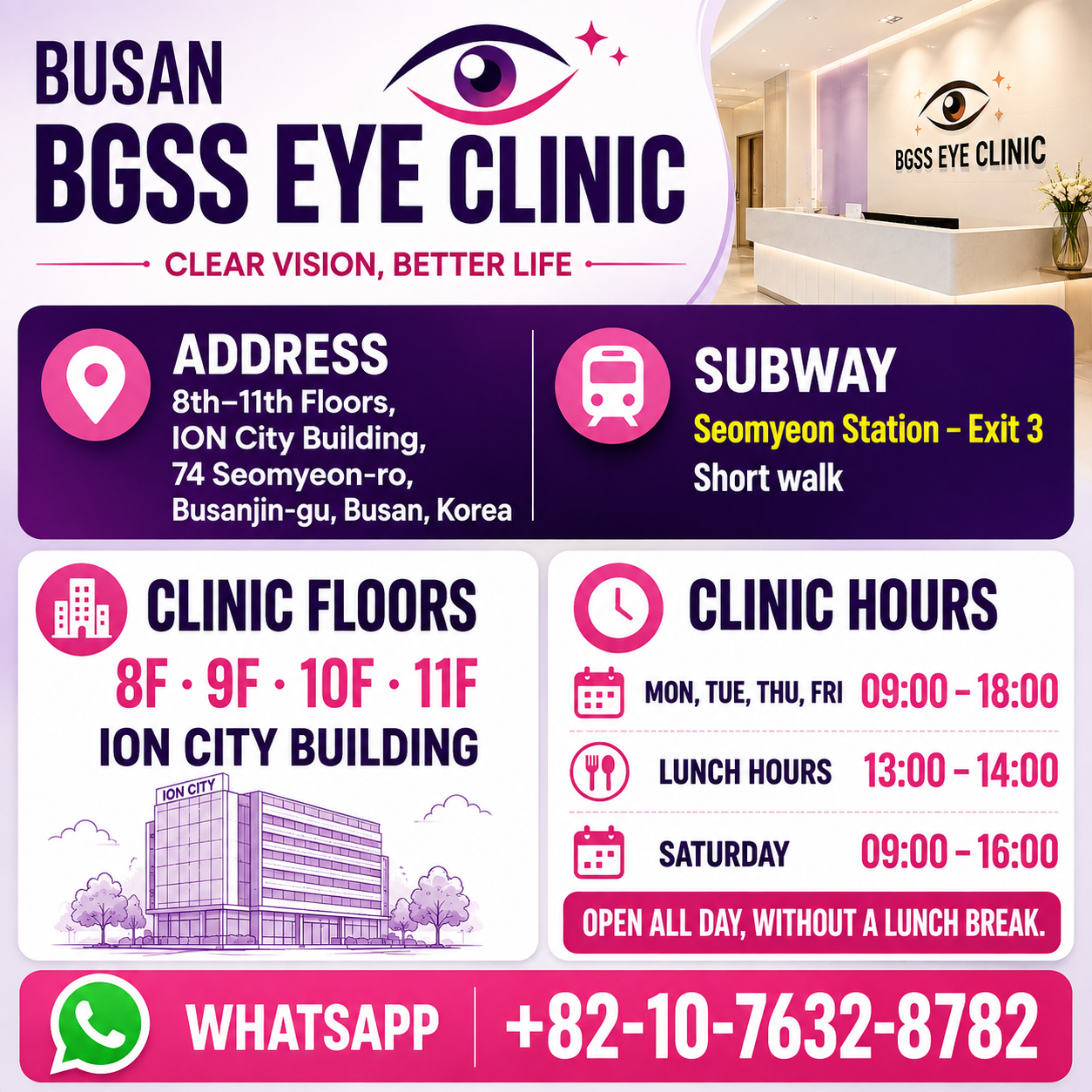
Not every eye clinic is located directly beside Seomyeon Station.
Some may be several blocks away or inside medical and commercial buildings.
Before traveling, confirm:
- Clinic address
- Building name
- Entrance
- Floor number
- Nearest subway exit
- Walking time from the station
Do not rely solely on the clinic's neighborhood name.
How to Get to Seomyeon by Subway
Busan Metro Line 1
Line 1 runs through major parts of Busan and stops at Seomyeon.
It can be useful for patients traveling from areas along the Line 1 corridor.
Busan Metro Line 2
Line 2 also serves Seomyeon and connects the area with other important parts of the city.
This can be particularly useful for patients staying in areas along the Line 2 route.
Seomyeon as a Transfer Station
If your accommodation is not directly on Line 1 or Line 2, you may need to transfer.
Before surgery, transfers are usually straightforward once you understand the station layout.
After surgery, however, minimizing unnecessary transfers may make your journey more comfortable.
Find Your Exact Subway Exit
The Exit Can Matter as Much as the Station
Seomyeon is a large and busy station.
A clinic may be much closer to one exit than another.
Walking out of the wrong exit can add significant distance to your journey.
Before leaving your hotel, check:
- Recommended exit
- Street name
- Building name
- Clinic floor
- Walking route
Save this information on your phone.
Use a Map Before Leaving the Hotel
Plan the Route in Advance
If you are an international visitor, navigating a large station while your vision is blurry can be stressful.
Before leaving, identify:
- Your starting station
- Direction of travel
- Transfer station, if any
- Seomyeon exit
- Walking route to the clinic
Screenshots or offline directions can be useful.
Can You Use the Subway Before Eye Surgery?
Usually More Practical Than After Surgery
Before surgery, most patients can use public transportation normally unless their ophthalmologist has provided different instructions.
If you are attending a preoperative examination, bring:
- Passport or identification if required
- Previous eye records
- Glasses prescription
- Contact lens information
- Medication list
- Clinic appointment details
Arrive early enough to allow for station navigation.
What If You Are Going for a Pre-LASIK Examination?
Leave Enough Time for Testing
A pre-LASIK consultation can involve several diagnostic tests.
Your appointment may include assessments such as:
- Refraction
- Corneal topography
- Corneal tomography
- Pachymetry
- Tear-film evaluation
- Pupil measurement
- Eye pressure
- Dilated examination when appropriate
The exact tests vary by clinic and procedure.
Do not schedule another important activity immediately afterward.
Can You Take the Subway After LASIK?
Ask Your Surgeon
Whether public transportation is appropriate immediately after LASIK depends on your vision and your surgeon's instructions.
Some patients experience relatively quick functional improvement, but temporary:
- Blurry vision
- Light sensitivity
- Glare
- Halos
- Dryness
can make subway travel uncomfortable.
A taxi or companion may be preferable immediately after surgery.
Can You Take the Subway After SMILE Pro?
Recovery Is Individual
SMILE Pro can have a relatively rapid functional recovery for many patients, but this does not mean everyone should immediately resume normal travel.
Your ophthalmologist should confirm when public transportation is appropriate.
If your vision is still fluctuating, avoid traveling alone if possible.
Can You Take the Subway After ICL?
Postoperative Monitoring Is Important
ICL involves implantation of a lens inside the eye.
After surgery, follow-up examinations are important to evaluate:
- Eye pressure
- Lens position
- Inflammation
- Visual acuity
- Overall healing
Ask your clinic whether you should use a taxi for your first postoperative journey.
What About LASEK or PRK?
Early Recovery May Be More Demanding
Surface-ablation procedures such as LASEK and PRK can involve a more gradual early recovery.
Temporary discomfort, light sensitivity, and visual fluctuations may make subway travel less appealing.
Plan for transportation that minimizes unnecessary walking and transfers.
Why Can the Subway Feel Uncomfortable After Eye Surgery?
Station Lighting
Subway stations can contain bright artificial lighting.
If you are experiencing postoperative light sensitivity, this may be uncomfortable.
Crowds
Busy stations require more awareness of your surroundings.
If your vision is temporarily blurry, navigating crowds can be difficult.
Stairs and Escalators
Large stations may involve considerable walking.
If you are tired after surgery, an elevator may be preferable when available.
Transfers
Changing lines can increase walking and navigation demands.
A direct route may be preferable during early recovery.
Should You Wear Sunglasses in the Subway?
Comfort Depends on Your Symptoms
Some patients experience light sensitivity after refractive surgery.
If your ophthalmologist recommends sunglasses, they may make the transition between outdoor and indoor environments more comfortable.
However, very dark lenses may make it harder to see in dim environments.
Choose whatever your eye-care professional recommends and prioritize safe navigation.
Can You Use Your Phone in the Subway?
Avoid Unnecessary Screen Time
Your phone can be useful for:
- Maps
- Translation
- Clinic contact
- Transportation information
However, prolonged screen use may worsen dryness or visual fatigue.
Use your phone when needed and take breaks.
What About Translation Apps?
Useful for International Patients
Translation apps can help with:
- Clinic addresses
- Subway directions
- Medical terminology
- Communication with staff
Save important clinic information before leaving your hotel.
This reduces the need to stare at your phone while navigating.
Can You Eat or Drink on the Subway?
Follow Public Transportation Rules
Avoid eating or drinking on the train unless specifically permitted.
If you need water or medication, handle it before entering the train or at an appropriate location.
Should You Travel During Rush Hour?
Consider Traveling Outside Peak Times
Seomyeon can become very busy.
If your appointment schedule allows, traveling outside the busiest periods may be more comfortable.
This is especially relevant after surgery when:
- Vision may be blurry
- Eyes may be sensitive to light
- You may feel tired
- You may want to avoid crowded spaces
How Early Should You Leave Your Hotel?
Give Yourself Extra Time
Do not plan to arrive at the station just before your appointment.
Allow time for:
- Finding the station entrance
- Buying or using your transportation card
- Waiting for a train
- Transfers
- Finding the correct exit
- Walking to the clinic
International patients should allow additional time if they are unfamiliar with Busan.
What Transportation Card Should Tourists Use?
T-money and Other Transit Options
Visitors can use rechargeable transportation cards and other available payment methods for public transportation in Korea.
Before traveling, check the current payment options available for your route.
If you are staying in Korea for several days, a rechargeable transit card can simplify repeated journeys.
Can You Take a Taxi Instead?
Sometimes It Is the Better Choice
A taxi can be particularly useful:
- Immediately after surgery
- When your vision is blurry
- During bad weather
- When carrying luggage
- When traveling late at night
- When you need to minimize walking
You can ask your hotel to help arrange transportation if necessary.
Taxi vs Subway for Eye Clinic Visits
Before Surgery
The subway may be convenient and economical.
Immediately After Surgery
A taxi may be more comfortable if your vision is temporarily impaired.
For Follow-Up Appointments
Once your vision is stable and your surgeon approves normal travel, either option may be reasonable.
What Should You Do If You Feel Dizzy or Disoriented?
Stop and Sit Down
If you feel overwhelmed while navigating the station:
- Move to a safe area
- Sit down
- Ask station staff for help
- Contact your clinic or companion
- Avoid rushing
Do not continue walking through a crowded station if you cannot see comfortably.
Can Station Staff Help Foreign Visitors?
Ask for Assistance
Busan Metro stations have staff who can assist passengers.
If you are unsure where to go, show your clinic address or station information.
Having the clinic name and address written in Korean can make communication easier.
What If You Have a Postoperative Appointment?
Keep the Trip Simple
For an early follow-up appointment:
- Leave your hotel with extra time
- Avoid unnecessary sightseeing
- Use the simplest transportation route
- Bring your prescribed eye drops
- Bring your clinic information
- Return to your hotel afterward if needed
A follow-up appointment should not be treated as an opportunity for a full day of sightseeing unless your doctor says you are ready.
Can You Walk From Seomyeon Station to Your Eye Clinic?
Check the Exact Distance
Some clinics may be only a few minutes from a subway exit.
Others may require a longer walk.
Consider:
- Sidewalk conditions
- Crosswalks
- Traffic
- Weather
- Stairs
- Your postoperative vision
If the walk feels difficult, use a taxi for the final portion.
What Should You Carry to the Clinic?
Keep Your Medical Information Accessible
Bring:
- Passport or identification
- Appointment confirmation
- Previous eye records
- Current prescription
- Medication list
- Sunglasses if recommended
- Prescribed eye drops
- Emergency contact information
International patients should keep copies of important medical records.
What Should You Avoid After Surgery?
Follow Your Clinic's Restrictions
Depending on the procedure, your surgeon may temporarily restrict:
- Swimming
- Contact sports
- Heavy exercise
- Eye rubbing
- Makeup around the eyes
- Certain outdoor activities
- Driving
Do not assume that taking the subway means all normal activities have resumed.
How Should You Plan Your Hotel Location?
Stay Close to the Clinic During Early Recovery
If your eye clinic is in Seomyeon, staying nearby can reduce transportation demands.
Look for accommodation with:
- Short walking distance
- Easy taxi access
- Elevator
- Quiet rooms
- Nearby restaurants
- Convenience stores
- Flexible booking policies
A hotel near the clinic can be especially helpful for early postoperative appointments.
How to Plan a Subway-Friendly Eye Surgery Trip
Before Surgery
Use the subway to explore Busan and attend your consultation if convenient.
Surgery Day
Plan transportation in advance and consider a taxi or companion.
Early Recovery
Minimize unnecessary travel and prioritize follow-up appointments.
Later Recovery
Once your ophthalmologist clears you for normal activity, gradually resume subway travel and sightseeing.
When Should You Avoid the Subway?
Choose Another Transportation Option If
You have:
- Significant blurry vision
- Severe light sensitivity
- Dizziness
- Significant eye pain
- Difficulty navigating
- A clinic-specific restriction against traveling alone
A taxi or companion may be more appropriate.
What Symptoms Require Urgent Eye Care?
Do Not Ignore Sudden Changes
Contact your eye clinic promptly if you experience:
- Sudden significant vision loss
- Severe or increasing eye pain
- Marked redness
- Significant discharge
- Rapidly worsening vision
- New flashes
- Sudden increase in floaters
- Severe or worsening light sensitivity
Follow your clinic's emergency instructions if they differ from general advice.
Conclusion
The Busan subway can be a convenient way for international patients to reach eye clinics in Seomyeon, particularly before surgery and later in recovery.
Seomyeon is served by major Busan Metro lines, but the station is large, so finding the correct exit and planning the final walk to your clinic are important.
Before surgery, public transportation is often a practical option for many visitors. Immediately after LASIK, SMILE Pro, ICL, LASEK, PRK, or another eye procedure, however, your transportation choice should depend on your postoperative vision and your ophthalmologist's instructions.
If you are experiencing blurry vision, light sensitivity, or discomfort, a taxi and companion may be more comfortable than navigating a busy station.
For international patients, the best strategy is to plan the route in advance, allow extra time, keep clinic information accessible, and prioritize medical appointments over sightseeing.
The subway can help you explore Busan—but during eye-surgery recovery, the simplest and safest journey is usually the best one.
FAQs About the Busan Subway for Eye Clinic Visitors
1. Is Seomyeon easy to reach by subway?
Yes. Seomyeon is an important Busan Metro station served by Lines 1 and 2, making it accessible from many parts of Busan.
2. Which subway line goes to Seomyeon?
Both Busan Metro Line 1 and Line 2 serve Seomyeon Station.
3. Can I take the subway after LASIK?
You may be able to once your ophthalmologist permits normal travel. If your vision is blurry or you are sensitive to light, a taxi may be more comfortable immediately after surgery.
4. Can I take the subway after SMILE Pro?
Some patients can resume public transportation relatively quickly, but your surgeon should determine when it is appropriate based on your recovery.
5. Can I take the subway after ICL surgery?
Ask your surgeon. Because ICL is an intraocular procedure, postoperative monitoring is important, and a taxi may be preferable for the first trip after surgery.
6. Is Seomyeon Station difficult for international visitors?
The station can be busy and extensive. Checking your clinic's exact exit and route before leaving your hotel can make the journey easier.
7. Should I use a taxi instead of the subway after eye surgery?
A taxi may be preferable when your vision is temporarily blurry, you have significant light sensitivity, or you need to minimize walking and transfers.
8. Can I use my phone for directions after eye surgery?
You can use it when necessary, but prolonged screen use may increase dryness or visual fatigue. Save directions in advance when possible.
9. Should I avoid rush hour after eye surgery?
If possible, traveling outside the busiest periods may be more comfortable because stations and trains can be crowded.
10. What should I do if my vision suddenly worsens while traveling to my clinic?
Stop in a safe location and contact your eye clinic promptly. Sudden significant vision changes, severe eye pain, marked redness, or rapidly worsening vision require prompt ophthalmic assessment.