LASIK for Nurses Working Night Shifts in Korea: What to Know
Introduction
Nurses who work night shifts have unique visual demands. Hospital corridors may be dim, patient rooms can have changing levels of illumination, and nurses may need to move quickly between bright clinical areas and darker environments.
For nurses considering LASIK in Korea, the decision should therefore involve more than asking whether their glasses prescription can be corrected.
Night-shift nurses may place particular importance on clear vision in low-light environments, comfortable computer and chart use, stable vision during long shifts, and reliable night driving after work.
LASIK can reduce dependence on glasses or contact lenses for appropriately selected patients, but it does not guarantee perfect vision in every lighting condition. Dry eye, glare, halos, starbursts, fluctuating vision, and reduced visual quality in dim conditions are recognized potential effects of refractive surgery.
For international nurses, foreign healthcare workers, and expats living in South Korea, this guide explains what to consider before choosing LASIK and how night-shift work may affect the decision.
Why Night-Shift Nurses Need to Think Carefully About LASIK
Night Work Creates Different Visual Demands
A typical daytime office worker may spend most of the day in relatively consistent lighting.
A nurse working overnight can experience much more variation.
During one shift, you might move between:
- Bright treatment rooms
- Dim patient rooms
- Hallways
- Computer screens
- Medication areas
- Outdoor darkness
- Bright ambulance or emergency lighting
Your eyes need to adapt repeatedly between different levels of illumination.
This does not automatically make LASIK unsuitable, but it makes night-vision quality an important part of the consultation.
Night Vision Is Different From Daytime Visual Acuity
A person can achieve excellent visual acuity on an eye chart and still experience visual symptoms in low-light conditions.
After LASIK, some patients experience glare, halos, starbursts, ghost images, or reduced contrast in dim lighting. The FDA specifically warns that some patients can experience visual symptoms that affect nighttime vision.
For a nurse, this distinction matters because hospital work is not performed exclusively under bright examination-room lighting.
Can Nurses Working Night Shifts Have LASIK?
Night-Shift Work Is Not Automatically a Contraindication
Working overnight does not by itself mean that you cannot undergo LASIK.
The more important question is whether your eyes are healthy and whether your visual demands and expectations are compatible with the potential benefits and limitations of surgery.
A preoperative assessment may evaluate:
- Stable prescription
- Corneal thickness
- Corneal shape
- Tear-film quality
- Dry-eye symptoms
- Pupil size
- Existing eye conditions
- Overall ocular health
- Your occupational visual requirements
The FDA recommends evaluation of factors including corneal thickness, tear production, pupil size, and other conditions before LASIK.
Your Occupation Should Be Discussed
A refractive-surgery consultation should include your actual work environment.
Tell the surgeon that you:
- Work night shifts
- Work in a hospital or healthcare environment
- Use computer screens
- Read small print
- Move between different lighting conditions
- May drive after work
- Need reliable vision during long shifts
Occupational requirements can influence procedure selection and counseling.
How Can Night Shifts Affect Dry Eye?
Dry Eye Is Important Before LASIK
Dry eye is one of the major considerations before LASIK.
LASIK can temporarily worsen or cause dry-eye symptoms, and significant pre-existing dry eye may increase concern about postoperative symptoms.
Night-shift nurses may also experience environmental factors that make ocular comfort more challenging.
For example, hospital environments can involve:
- Air conditioning
- Fans or ventilation
- Long periods of screen use
- Reduced blinking during concentrated tasks
- Extended working hours
- Fatigue
These factors do not mean that LASIK will cause problems, but they make preoperative ocular-surface assessment especially important.
What Does Dry Eye Feel Like?
Possible symptoms include:
- Burning
- Grittiness
- Scratchiness
- Irritation
- Excessive tearing
- Light sensitivity
- Intermittent blurry vision
Dryness can also reduce visual quality.
The FDA notes that postoperative dry eye can sometimes cause intermittent blurring and other visual symptoms.
Should Night-Shift Nurses Treat Dry Eye Before LASIK?
Yes, If the Ocular Surface Is Not Healthy
If your examination shows significant dry eye, blepharitis, or meibomian-gland dysfunction, your surgeon may recommend treating the ocular surface before considering surgery.
The goal is not simply to make the eye feel more comfortable.
A healthy ocular surface can also make preoperative measurements and postoperative recovery more predictable.
Do not assume that frequent use of artificial tears automatically makes you ready for LASIK. The underlying cause of dryness should be evaluated.
Why Pupil Size Matters for Night-Shift Nurses
Pupils Become Larger in Darkness
Your pupils naturally enlarge in dim environments.
This is relevant to refractive surgery because optical symptoms such as glare and halos can become more noticeable under low-light conditions.
The FDA specifically recommends evaluating pupil size in a dark environment because larger pupils can be associated with symptoms such as glare, halos, starbursts, and ghost images after LASIK.
For a nurse who works overnight, this assessment can be particularly relevant.
Ask About Your Night-Vision Risk
Before surgery, ask your surgeon:
- What is my pupil size in darkness?
- Do I have risk factors for postoperative halos?
- How large is my treatment zone?
- How might my prescription affect night vision?
- Could I still need glasses for certain nighttime activities?
These questions are more useful than simply asking whether the procedure will give you “20/20 vision.”
Can LASIK Affect Night Driving?
Night Driving Deserves Special Attention
If you drive home after a night shift, nighttime visual quality is an important occupational and safety consideration.
LASIK can be associated with glare, halos, starbursts, ghost images, and reduced visual quality in low-light conditions. The FDA specifically identifies difficulty with nighttime driving as a potential postoperative issue.
This does not mean that every LASIK patient develops significant night-driving problems.
It means that the possibility should be discussed before surgery.
Do Not Assume You Can Drive Immediately After Surgery
Even when visual recovery is progressing well, you should follow your surgeon's instructions regarding driving.
Your ability to drive safely depends on your visual function and postoperative recovery, not simply on how quickly the procedure was performed.
Can LASIK Make Hospital Work Easier?
Reducing Dependence on Glasses Can Be Convenient
For some nurses, reducing dependence on glasses or contact lenses can be particularly convenient.
Potential practical advantages include:
- Less dependence on glasses during long shifts
- No glasses fogging from masks
- Less need to manage contact lenses
- Easier use of protective equipment
- Greater convenience during emergencies
- Reduced dependence on corrective lenses during physical activity
However, LASIK is intended to reduce dependence on corrective lenses, not guarantee that glasses will never be needed again.
Some patients still need glasses for particular tasks after surgery.
What About Contact Lenses for Night-Shift Nurses?
LASIK May Be Attractive to Contact-Lens Users
Some nurses use contact lenses because glasses can interfere with masks, protective equipment, or personal comfort.
However, contact lenses can also cause dryness and discomfort during long shifts.
If you currently wear contacts for extended periods, tell your surgeon.
The preoperative examination should assess your cornea and ocular surface rather than assuming that contact-lens intolerance automatically makes you a LASIK candidate.
How Long Should a Nurse Take Off Work After LASIK?
Recovery Should Be Planned Around Your Shift Schedule
The appropriate time away from work varies between patients and depends on the procedure, healing, workplace environment, and surgeon's instructions.
Night-shift nurses should avoid planning surgery immediately before a demanding series of overnight shifts.
You may want to discuss:
- When you can return to work
- When you can safely work overnight
- When you can use hospital screens normally
- When you can resume driving
- When you can use makeup
- When you can exercise
- When postoperative follow-up is required
Your surgeon should provide individualized restrictions.
Do Not Schedule Surgery Around Your Busiest Roster
A practical approach is to choose a period when you can reasonably rest and attend follow-up appointments.
This is particularly important if your schedule changes frequently.
Can Screen Use During Night Shifts Affect LASIK Recovery?
Computer Work May Feel Uncomfortable Early On
Nurses often use electronic medical records, medication systems, monitors, and other digital equipment.
After LASIK, temporary dryness or fluctuating vision can make prolonged screen use uncomfortable.
Screen concentration can also reduce blinking, which may worsen ocular-surface symptoms.
This does not mean that nurses must avoid screens permanently.
Instead, follow the postoperative instructions from your ophthalmologist and use recommended lubrication if prescribed.
What Preoperative Tests Should Night-Shift Nurses Have?
Comprehensive LASIK Screening
A thorough examination may include:
- Refraction
- Best-corrected visual acuity
- Corneal topography
- Corneal tomography
- Corneal thickness measurement
- Tear-film or dry-eye assessment
- Pupil-size assessment
- Slit-lamp examination
- Eye-pressure measurement
- Retinal examination when appropriate
The exact testing protocol varies by clinic and patient.
Why Corneal Testing Matters
LASIK permanently reshapes the cornea.
The surgeon therefore needs to determine whether your corneal thickness and shape are appropriate for the planned procedure.
Thin corneas or abnormal corneal anatomy can increase the risk of complications and may make LASIK inappropriate.
What If a Nurse Is Not a Good Candidate for LASIK?
Other Vision-Correction Options May Exist
LASIK is not the only refractive procedure.
Depending on your prescription and eye anatomy, an ophthalmologist may discuss alternatives such as:
- PRK
- LASEK
- SMILE
- Phakic ICL
The appropriate procedure depends on your individual anatomy and visual requirements.
A nurse should not choose a procedure simply because it has the shortest advertised recovery period.
LASIK vs Other Procedures for Night-Shift Nurses
LASIK
LASIK uses a corneal flap and excimer-laser reshaping.
Its potential advantage is relatively rapid visual recovery for appropriately selected patients.
However, dry eye and night-vision symptoms remain important considerations.
PRK or LASEK
Surface-based procedures do not create the same LASIK corneal flap.
They may be considered in certain patients when corneal or occupational factors make LASIK less attractive.
Recovery can be slower, however.
SMILE
SMILE uses a small corneal incision and removes a lenticule from the cornea.
It may be appropriate for selected patients with myopia or myopic astigmatism.
The surgeon should determine whether it provides the best balance of safety, visual quality, and recovery for your specific eyes.
ICL
An implantable collamer lens corrects refractive error using an implanted lens rather than reshaping the cornea.
It may be considered for selected patients, particularly when prescription or corneal characteristics make laser surgery less appropriate.
Can Night-Shift Fatigue Affect the Decision to Have LASIK?
Fatigue Does Not Automatically Make Surgery Unsafe
Working nights and feeling tired do not automatically disqualify you from LASIK.
However, fatigue can affect how comfortably you manage recovery and follow postoperative instructions.
If your schedule makes it difficult to:
- Sleep adequately
- Attend follow-up appointments
- Use prescribed drops
- Avoid rubbing your eyes
- Follow activity restrictions
you may want to schedule surgery during a more manageable period.
LASIK for Nurses in Korea: Choosing a Clinic
Look Beyond the Advertising
If you are searching for LASIK for nurses in Korea, look for a clinic that performs a detailed preoperative assessment rather than making a recommendation based only on your prescription.
Important questions include:
- Which laser platform is used?
- How is corneal thickness evaluated?
- Is corneal tomography performed?
- Is dry eye assessed?
- Are pupils evaluated under low-light conditions?
- How are night-vision concerns discussed?
- What happens if LASIK is not suitable?
- What follow-up is included?
The FDA also recommends considering surgeon experience, equipment, informed consent, and long-term follow-up when selecting a LASIK provider.
LASIK for International Nurses Working in Korea
Bring Your Previous Eye Records
If you are an international nurse working in South Korea, bring:
- Previous glasses prescriptions
- Contact-lens prescription
- Previous eye examinations
- Corneal imaging if available
- Previous eye-surgery records
- Current medications
A stable prescription is important when considering refractive surgery.
Explain Your Work Schedule
Tell the ophthalmologist:
- How many night shifts you work
- Whether you rotate between day and night shifts
- Whether you drive after work
- How much screen time your job involves
- Whether you work in emergency care
- Whether you frequently work in dimly lit areas
Your occupation is relevant to your visual goals.
LASIK in Busan for Night-Shift Nurses
What Should You Look For?
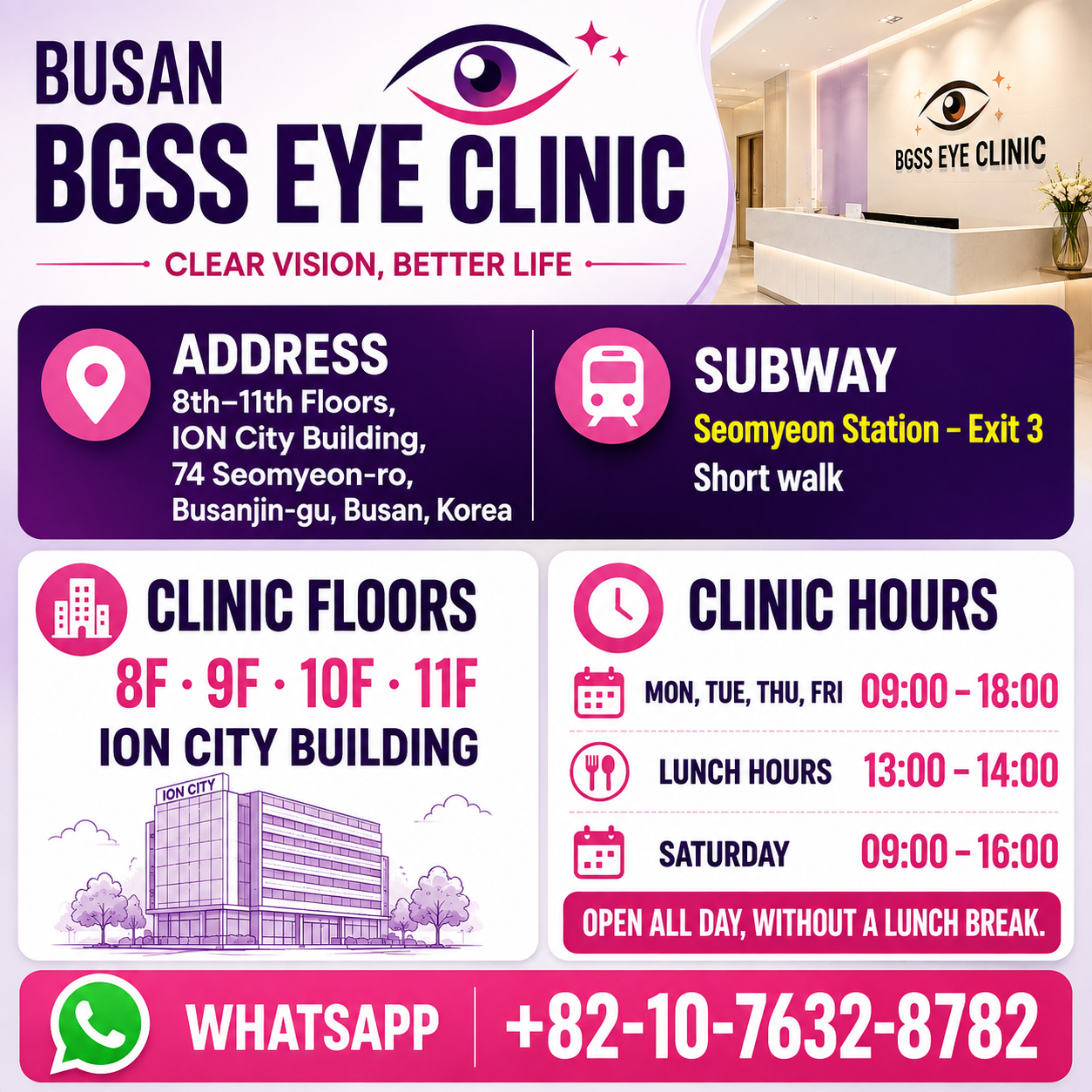
If you are looking for LASIK in Busan, Korea, consider an eye clinic that can provide comprehensive refractive-surgery screening.
Useful capabilities may include:
- Corneal topography
- Corneal tomography
- Dry-eye evaluation
- Pupil assessment
- Wavefront or other optical analysis when appropriate
- Multiple refractive-surgery options
- Postoperative follow-up
The best procedure cannot be selected from the prescription alone.
Plan Follow-Up Around Your Nursing Schedule
Before surgery, ask the clinic how many postoperative appointments are normally recommended and when they occur.
This is particularly important if you work rotating or overnight shifts.
What Should Nurses Ask Before LASIK?
Questions About Night Vision
Ask:
- How likely am I to experience glare or halos?
- How large are my pupils in low light?
- Could LASIK affect my night vision?
- Will I be able to drive safely after recovery?
- Could I still need glasses for night driving?
Questions About Dry Eye
Ask:
- Do I have dry eye before surgery?
- Is my tear film healthy enough for LASIK?
- Could my night-shift work worsen postoperative dryness?
- How long might I need lubricating drops?
Questions About Work
Ask:
- When can I safely return to night shifts?
- When can I use hospital computer systems normally?
- When can I wear required protective equipment?
- When can I return to a full nursing workload?
- What should I do if my vision fluctuates during a shift?
When Should a Nurse Delay LASIK?
Unstable Prescription
If your prescription has recently changed, your surgeon may recommend waiting until it becomes stable.
Refractive instability is one of the factors considered when determining LASIK suitability.
Significant Dry Eye
Significant uncontrolled dry eye may need treatment before surgery.
LASIK can aggravate pre-existing dry eye.
Abnormal Corneal Findings
Conditions such as keratoconus or other corneal abnormalities may make LASIK inappropriate.
Your surgeon should evaluate corneal shape and thickness carefully.
Pregnancy or Breastfeeding
Hormonal changes associated with pregnancy and breastfeeding can affect refractive stability and may be a reason to delay elective refractive surgery.
What Happens After LASIK?
Early Recovery
Vision may improve quickly, but the early postoperative period can involve fluctuations.
Possible symptoms include:
- Dryness
- Light sensitivity
- Glare
- Halos
- Fluctuating vision
- Mild discomfort
These symptoms often improve during recovery, but some can persist in a minority of patients.
Follow-Up Is Important
Your ophthalmologist may monitor:
- Visual acuity
- Corneal healing
- Eye pressure
- Dry-eye symptoms
- Residual refractive error
- Visual quality
- Other postoperative findings
Do not return to demanding night-shift work simply because your vision appears clear immediately after surgery.
Follow the surgeon's specific recovery instructions.
Can Nurses Return to Night Shifts After LASIK?
There Is No Universal Return-to-Work Date
The appropriate timing varies.
A nurse may be ready for work only after the surgeon confirms that healing and visual function are adequate for the job.
A particularly demanding position may require more caution than a role involving less visually intensive work.
Emergency nurses, operating-room staff, intensive-care nurses, and nurses who drive after work should discuss their specific requirements with the surgeon.
When Should a Nurse Seek Medical Attention After LASIK?
Do Not Ignore Significant Changes
Contact your eye-care provider promptly if you experience:
- Significant or worsening vision loss
- Severe or increasing eye pain
- Marked redness
- New discharge
- Sudden major visual changes
- Severe light sensitivity
- Other symptoms that concern you
Do not assume that a serious postoperative symptom is simply part of normal recovery.
Conclusion
LASIK can be an option for appropriately selected nurses working night shifts in Korea, but nighttime visual demands deserve particular attention before surgery.
Night-shift nurses may work in changing lighting conditions, use digital screens for extended periods, and sometimes drive in darkness after work. These factors make dry-eye assessment, pupil evaluation, night-vision counseling, and realistic expectations particularly important.
LASIK can reduce dependence on glasses or contact lenses, but it does not guarantee perfect vision under every lighting condition. Glare, halos, starbursts, dry eye, fluctuating vision, and reduced visual quality in dim conditions are recognized potential risks.
For nurses considering LASIK in Korea, the right procedure should be selected based on corneal anatomy, prescription, ocular-surface health, visual demands, and occupational requirements.
If LASIK is not the best option, alternatives such as PRK, LASEK, SMILE, or ICL may be considered depending on the individual patient.
For international nurses and expats in Busan, bringing previous eye records and explaining your exact night-shift schedule can help the ophthalmologist develop a more appropriate treatment plan.
The goal should not simply be to eliminate glasses. It should be to achieve safe, comfortable, and useful vision for both clinical work and everyday life.
FAQs About LASIK for Nurses Working Night Shifts in Korea
1. Can nurses who work night shifts have LASIK?
Yes. Working night shifts does not automatically prevent someone from having LASIK. Candidacy depends on eye health, corneal anatomy, prescription stability, dry-eye status, and individual visual requirements.
2. Is LASIK safe for nurses who work in hospitals at night?
LASIK can be appropriate for selected patients, but nurses should discuss their occupational visual demands with the surgeon. Nighttime glare, halos, dry eye, and low-light visual quality are important considerations.
3. Can LASIK cause problems with night vision?
Some patients experience glare, halos, starbursts, ghost images, or reduced visual quality in dim lighting after LASIK. These symptoms often improve but can persist in some patients.
4. Can I drive home after a night shift following LASIK?
You should not assume that you can drive immediately after surgery. Your surgeon should determine when your vision is adequate and it is safe to resume driving.
5. Does working night shifts increase dry-eye risk after LASIK?
Night-shift work itself does not automatically mean you will develop dry eye, but long shifts, screen use, environmental conditions, and reduced blinking can contribute to ocular discomfort. Pre-existing dry eye should be evaluated before surgery.
6. Should nurses have their pupils checked before LASIK?
Yes. Pupil size in low-light conditions can be relevant when assessing potential nighttime visual symptoms. The FDA specifically recommends evaluation of pupil size as part of LASIK risk assessment.
7. How long should I take off work after LASIK?
There is no universal period that applies to every nurse. Recovery and return-to-work timing depend on healing, visual function, job requirements, and your surgeon's instructions.
8. Can I use hospital computers after LASIK?
Screen use may be uncomfortable during early recovery because of dryness or fluctuating vision. Follow your surgeon's instructions and return to prolonged screen work when your eyes are ready.
9. What if LASIK is not suitable for a night-shift nurse?
Depending on your prescription and eye anatomy, an ophthalmologist may discuss alternatives such as PRK, LASEK, SMILE, or ICL.
10. Where can international nurses get LASIK evaluation in Korea?
International patients can seek refractive-surgery evaluations in South Korea, including Busan and Seoul. Look for a clinic that provides comprehensive corneal, dry-eye, pupil, and refractive assessments rather than choosing a procedure based only on your glasses prescription.