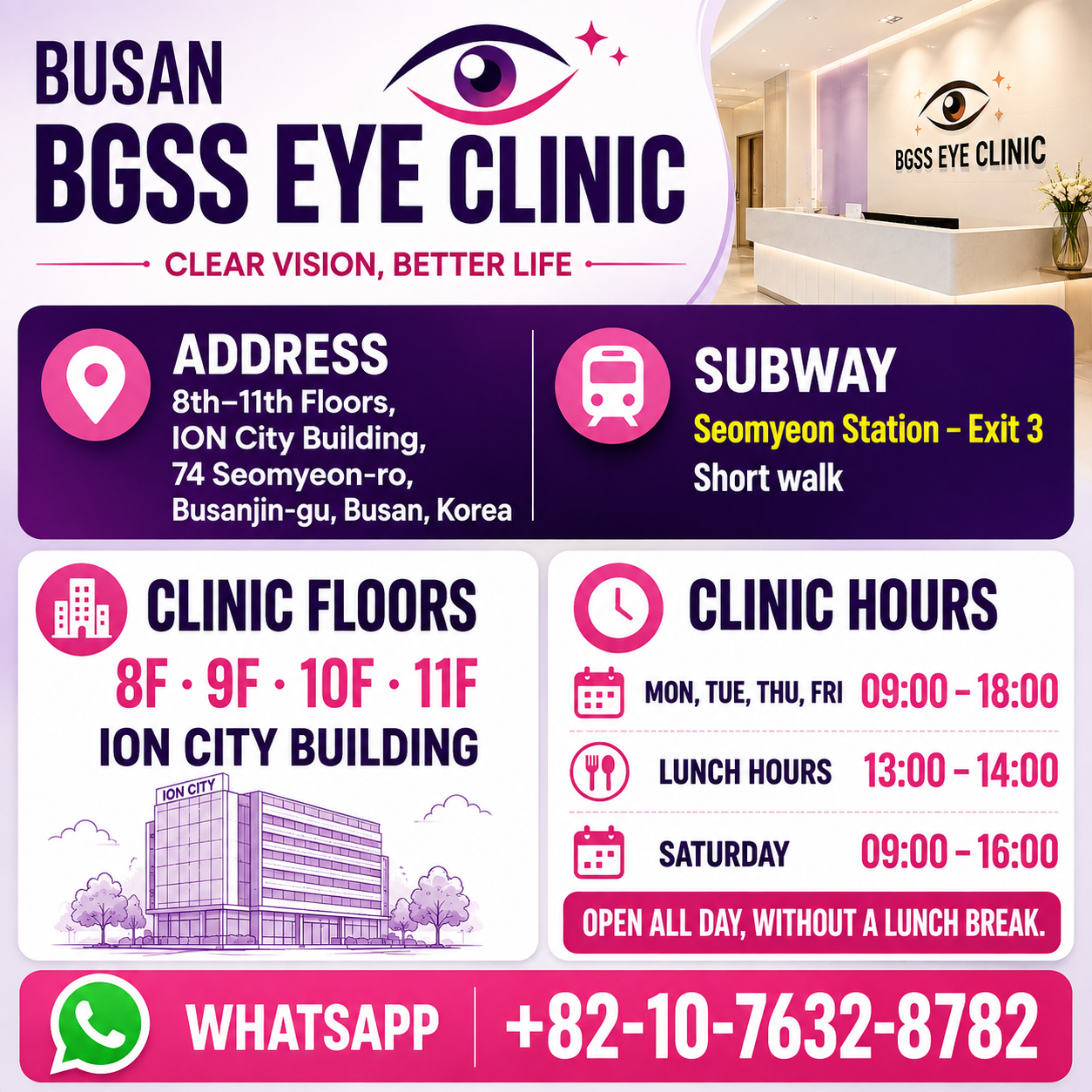
English Eye Consultations at Eye Clinics in Busan, Korea
Introduction
For international patients, expats, and travelers seeking eye care in South Korea, being able to communicate clearly with an ophthalmologist is an important part of the treatment experience. English eye consultations at eye clinics in Busan, Korea can make it easier for foreign patients to explain symptoms, understand diagnostic results, discuss treatment options, and follow postoperative instructions.
Busan is a major medical and international travel destination with ophthalmology services ranging from routine eye examinations to cataract evaluation, glaucoma screening, retinal assessment, dry-eye treatment, and vision-correction procedures such as LASIK, SMILE, SMILE Pro, and ICL.
However, English availability can differ between clinics and even between individual appointments. International patients should confirm language support before visiting, especially if they are considering surgery.
This guide explains what English-speaking eye consultations in Busan may involve, what to ask before booking, and how international patients can prepare for a smoother eye-care experience.
Why English Communication Matters in Eye Care
Eye Symptoms Can Be Difficult to Describe
Vision problems are not always easy to explain.
Patients may experience:
- Blurry vision
- Double vision
- Eye pain
- Dryness
- Burning
- Floaters
- Flashes
- Light sensitivity
- Distorted vision
- Difficulty seeing at night
Being able to describe when symptoms started, how they change, and which eye is affected can help the ophthalmologist understand the problem.
Medical Decisions Require Clear Understanding
When surgery or specialized treatment is being considered, communication becomes even more important.
Patients should understand:
- The diagnosis
- Available treatment options
- Expected benefits
- Possible risks
- Recovery time
- Medication instructions
- Follow-up requirements
An English consultation can make these discussions easier for patients who are more comfortable communicating in English.
What Happens During an English Eye Consultation?
Medical History
The ophthalmologist may begin by asking about your:
- Current symptoms
- Previous eye problems
- Eye surgery
- Glasses prescription
- Contact lens use
- Medications
- Allergies
- Family eye history
You should provide complete and accurate information.
Vision Testing
Depending on the reason for your visit, testing may include:
- Visual acuity
- Refraction
- Eye pressure
- Slit-lamp examination
- Corneal measurements
- Retinal examination
- OCT
- Visual field testing
- Other specialized imaging
Not every patient needs every test.
The examination should be based on your symptoms, age, medical history, and suspected condition.
English Consultation for Vision Correction
LASIK and Other Laser Procedures
International patients may visit Busan for procedures such as:
- LASIK
- LASEK
- PRK
- SMILE
- SMILE Pro
An English consultation can help patients understand whether they are suitable for laser vision correction.
The ophthalmologist may discuss:
- Prescription stability
- Corneal thickness
- Corneal shape
- Dry-eye status
- Expected visual results
- Potential side effects
- Recovery
SMILE and SMILE Pro Consultation
Patients interested in SMILE or SMILE Pro should not choose the procedure simply because it is a newer technology.
The ophthalmologist should assess the patient's individual eye characteristics and explain why a particular procedure may or may not be appropriate.
English Consultation for ICL
Understanding an Intraocular Procedure
ICL involves placing an implantable lens inside the eye.
Because it is an intraocular procedure, patients should clearly understand the potential benefits, limitations, risks, and follow-up requirements.
During an English consultation, ask about:
- Eligibility
- Lens selection
- Expected vision
- Potential complications
- Recovery
- Long-term monitoring
- What happens if the lens needs adjustment or removal
English Cataract Consultations in Busan
Discussing Cataract Symptoms
Patients may seek an English consultation when experiencing:
- Cloudy vision
- Glare
- Difficulty driving at night
- Faded colors
- Increasing dependence on glasses
- Difficulty reading
The ophthalmologist can determine whether cataracts are contributing to these symptoms.
Discussing Intraocular Lens Options
Cataract patients may have different IOL options depending on their eye health and visual needs.
The decision may involve:
- Distance vision
- Near vision
- Astigmatism
- Existing retinal conditions
- Lifestyle
- Visual expectations
Patients should understand what their recommended lens is designed to achieve rather than choosing based only on price or marketing.
English Glaucoma Consultations
When Eye Pressure Is a Concern
Patients may seek glaucoma evaluation because of:
- Elevated eye pressure
- Family history
- Suspicious optic nerve appearance
- Visual field changes
- Age-related risk
Testing may include eye pressure measurement, optic nerve evaluation, OCT, and visual field testing.
An English consultation allows patients to discuss the significance of their results and understand whether monitoring or treatment is recommended.
English Retina Consultations
For Floaters and Flashes
New floaters or flashes can sometimes be associated with changes in the vitreous or retina.
Patients should explain:
- When symptoms began
- Whether they appeared suddenly
- Whether they are increasing
- Whether vision has changed
- Whether a shadow or curtain has appeared
Sudden flashes, a sudden increase in floaters, or a curtain-like shadow over vision can require urgent retinal assessment.
Do not delay care simply because you are concerned about a language barrier.
English Dry-Eye Consultations
Discussing Chronic Dry Eye
Patients who spend long hours using computers, smartphones, or contact lenses may experience dry-eye symptoms.
An English consultation can help patients explain:
- Burning
- Gritty sensation
- Fluctuating vision
- Redness
- Excessive tearing
- Contact-lens intolerance
The ophthalmologist may assess tear-film stability, eyelids, and meibomian gland function before recommending treatment.
What Should International Patients Ask During the Consultation?
Questions About Diagnosis
Ask:
- What is causing my vision problem?
- Is the condition affecting one or both eyes?
- Do I need additional testing?
- Is this condition urgent?
- Could it become worse?
Questions About Treatment
Ask:
- What treatment options are available?
- Why do you recommend this option?
- Are there alternatives?
- What happens if I do not receive treatment?
- How successful is the treatment generally?
- What are the main risks?
Questions About Recovery
Ask:
- How long is recovery?
- When can I work?
- When can I exercise?
- When can I swim?
- When can I fly?
- Will I need additional appointments?
Confirm English Support Before Your Appointment
Do Not Assume Every Clinic Provides Full English Services
A clinic may advertise international-patient services while having different levels of English support.
Before booking, confirm whether English is available for:
- Doctor consultation
- Diagnostic testing
- Surgery consultation
- Consent forms
- Medication instructions
- Postoperative appointments
If an interpreter is used, ask whether interpretation is available during the actual medical consultation.
English Consultation Does Not Mean Every Document Is in English
Ask About Written Information
Medical forms, prescriptions, and instructions may not always be available in English.
Ask whether the clinic can provide English versions of important documents when needed.
For surgery, make sure you understand the consent information before signing.
Preparing for an English Eye Consultation
Bring Your Medical History
International patients should bring:
- Passport
- Current glasses
- Previous prescriptions
- Contact lens information
- Previous eye examination reports
- Surgical records
- OCT or retinal images
- Medication list
- Allergy information
Previous medical information can be especially useful when visiting a new ophthalmologist.
Write Down Your Symptoms
Before your appointment, note:
- When symptoms began
- Which eye is affected
- How frequently symptoms occur
- What makes them better or worse
- Whether vision has changed
This can help you communicate efficiently during the consultation.
English Eye Consultation for Expats in Busan
Ongoing Eye Care
Expats living in Busan may need regular eye care rather than a single medical-tourism visit.
English communication can be particularly useful for:
- Annual eye examinations
- Contact-lens problems
- Dry eye
- Glaucoma monitoring
- Diabetic eye screening
- Myopia management
- Cataract monitoring
Having a clinic that can communicate clearly in English may make long-term eye care easier.
English Eye Care for Tourists
Short-Term Visitors
Tourists may seek eye care because of:
- Sudden eye symptoms
- Lost or damaged glasses
- Contact-lens problems
- Eye irritation
- A planned surgical consultation
Tourists should explain their travel schedule to the ophthalmologist.
If surgery is being considered, tell the doctor when you need to leave Korea.
English Consultations for Medical Tourists
Planning Surgery in Busan
International patients considering eye surgery should plan for:
Consultation → Diagnostic testing → Treatment decision → Surgery → Follow-up → Return home
Avoid scheduling surgery immediately before your international flight.
Your surgeon should determine whether you have enough time for postoperative monitoring before leaving Korea.
Communication During Eye Surgery Planning
Make Sure You Understand the Numbers
Eye surgery consultations may involve technical information such as:
- Prescription
- Corneal thickness
- Corneal curvature
- Eye pressure
- Lens power
- Visual acuity
Do not hesitate to ask the ophthalmologist to explain unfamiliar measurements in simple English.
Questions About Cost
Ask for a Complete Estimate
International patients should ask whether the quoted price includes:
- Consultation
- Diagnostic tests
- Surgery
- Medication
- Follow-up
- Additional examinations
A low advertised procedure price may not represent the complete treatment cost.
Insurance and Payment
Confirm Coverage Before Treatment
Insurance coverage depends on the policy and type of eye treatment.
Elective vision correction may be treated differently from medically necessary cataract or retinal treatment.
Ask the clinic for appropriate documentation if you need to submit a claim to your insurer.
What Makes an English Eye Consultation Useful?
Better Communication
Patients can more easily explain their symptoms and concerns.
Better Understanding
Patients can ask questions about diagnosis, treatment, risks, and recovery.
Better Preparation
International patients can understand what they need to do before and after treatment.
Better Continuity of Care
Written medical information in English can also make it easier to communicate with an eye doctor in your home country after returning from Korea.
What to Do If Full English Support Is Not Available
Ask About Interpretation
If the ophthalmologist does not speak English fluently, ask whether a qualified interpreter is available.
For complex surgical decisions, professional interpretation may be preferable to relying on automatic translation.
Use Translation Tools Carefully
Translation apps can help with simple communication, but they should not replace proper medical interpretation when discussing significant risks, consent, or surgery.
Warning Signs That Need Urgent Eye Care
Do Not Wait for a Routine English Appointment If You Have:
- Sudden vision loss
- Sudden increase in floaters
- New flashes of light
- Curtain-like shadow
- Severe eye pain
- Significant eye injury
- Sudden major vision changes
These symptoms may require urgent ophthalmic assessment.
Language concerns should not delay emergency care.
How to Choose an English-Friendly Eye Clinic in Busan
Consider These Factors
Look for a clinic that offers:
- Qualified ophthalmologists
- Appropriate diagnostic equipment
- Clear international-patient communication
- English consultation support
- Detailed explanations
- Postoperative follow-up
- Emergency contact information
- Transparent pricing
Do not choose a clinic solely because it advertises English services.
The quality and suitability of the medical care remain the most important considerations.
A Simple Checklist for International Patients
Before Booking
☐ Confirm English consultation availability
☐ Ask whether an interpreter is available
☐ Check doctor qualifications
☐ Confirm the clinic's location
☐ Ask about diagnostic testing
☐ Request pricing information
Before the Appointment
☐ Bring previous eye records
☐ Bring glasses and contact lens information
☐ Prepare a medication list
☐ Write down your symptoms
☐ Prepare questions
Before Surgery
☐ Understand the recommended procedure
☐ Understand alternatives
☐ Review risks and benefits
☐ Confirm recovery time
☐ Confirm follow-up schedule
☐ Ask about flying home
Conclusion
English eye consultations at eye clinics in Busan, Korea can make eye care more accessible for international patients, tourists, and expats, particularly when diagnosis, surgery, and postoperative care require detailed communication.
Whether you are seeking a routine eye examination, cataract evaluation, glaucoma screening, retinal assessment, dry-eye treatment, LASIK, SMILE, SMILE Pro, or ICL, clear communication should be considered part of the overall medical experience.
Before booking an appointment, confirm exactly what English support the clinic provides. Bring your previous eye records, prepare a list of symptoms and medications, and ask questions about diagnosis, treatment alternatives, risks, recovery, and follow-up.
For patients considering surgery in Korea, the goal should not simply be finding an English-speaking clinic. The priority is finding an appropriately qualified ophthalmologist, receiving a comprehensive examination, understanding the recommended treatment, and having a clear plan for follow-up care.
With careful preparation, international patients can approach eye care in Busan with greater confidence and a better understanding of their treatment journey.
FAQs About English Eye Consultations in Busan
1. Can international patients get an eye consultation in English in Busan?
Some eye clinics in Busan provide English-language services for international patients. Availability varies, so patients should confirm English support before booking.
2. Can I have LASIK or SMILE discussed during an English consultation?
Yes, if the clinic provides English support for refractive surgery consultations. A comprehensive eye examination is still necessary to determine whether you are a suitable candidate.
3. Do English-speaking eye clinics in Busan treat emergency eye problems?
Some clinics may provide urgent ophthalmic care, but services vary. Sudden vision loss, flashes, a sudden increase in floaters, or a curtain-like shadow should be evaluated promptly.
4. What should I bring to an English eye consultation?
Bring your passport, glasses, previous prescriptions, medical records, medication list, contact lens information, and any previous eye-surgery documentation.
5. Do I need an interpreter if the doctor speaks English?
Not necessarily. If the ophthalmologist can communicate clearly with you in English, an interpreter may not be needed. For complex medical decisions, make sure you fully understand the information before consenting to treatment.
6. Can expats living in Busan use English-speaking eye clinics for regular checkups?
Yes, where clinics offer appropriate international-patient services, expats may use them for routine examinations and ongoing management of eye conditions.
7. Can tourists visit a Busan eye clinic without speaking Korean?
Yes, but it is best to confirm language support in advance and keep the clinic's Korean address available for transportation.
8. Can I discuss cataract surgery in English in Busan?
If the clinic provides English cataract consultations, you can discuss symptoms, examination results, IOL options, surgical risks, recovery, and follow-up.
9. Can I get an English medical report after my eye consultation?
This depends on the clinic. International patients should ask in advance whether English medical records, prescriptions, or reports can be provided.
10. How can I prepare for an English eye consultation in Korea?
Prepare your medical history, previous eye records, medication list, symptoms, and questions. Also confirm English support and appointment details before traveling to the clinic.