Cataract Consultation in Seomyeon, Busan: What to Expect
Cataract Consultation in Seomyeon, Busan: What to Expect
If your vision has become cloudy, blurry, or increasingly difficult to manage with glasses, a cataract consultation is an important first step before deciding whether surgery is appropriate. For international patients, expats, and visitors in South Korea, cataract consultation in Seomyeon, Busan can provide an opportunity to have your vision thoroughly evaluated and discuss treatment options with an ophthalmologist.
A cataract consultation is more than a simple vision test. The examination helps determine whether a cataract is actually causing your symptoms, how significantly it is affecting your vision, and whether cataract surgery could provide meaningful improvement.
In Seomyeon, patients can access ophthalmology services that offer cataract evaluations, lens consultations, and surgical planning.
For international patients, understanding what happens during the appointment can make the process much easier. Knowing what tests may be performed, what information to bring, and what questions to ask can also help you make a more informed decision about treatment.
What Is a Cataract Consultation?
The First Step Before Cataract Surgery
A cataract consultation is a comprehensive eye evaluation designed to determine whether you have a visually significant cataract and whether treatment may be appropriate.
During the consultation, the ophthalmologist may assess:
- Your current vision
- Your glasses prescription
- The condition of your natural lens
- Corneal shape and health
- Eye pressure
- Retinal health
- Astigmatism
- Overall eye health
- Your visual goals
For patients considering cataract surgery, additional measurements may be used to calculate the appropriate intraocular lens, or IOL.
You Do Not Automatically Need Surgery
Being diagnosed with a cataract does not necessarily mean you need surgery immediately.
If your cataract is mild and your vision remains functional, your ophthalmologist may recommend monitoring it or updating your glasses.
Surgery becomes more relevant when cataract-related vision loss begins interfering with daily activities such as reading, driving, working, or recognizing faces.
Why Have a Cataract Consultation in Seomyeon?
A Convenient Area for Eye Care in Busan
Seomyeon is one of Busan's major commercial and transportation areas, making it convenient for residents and visitors seeking medical care.
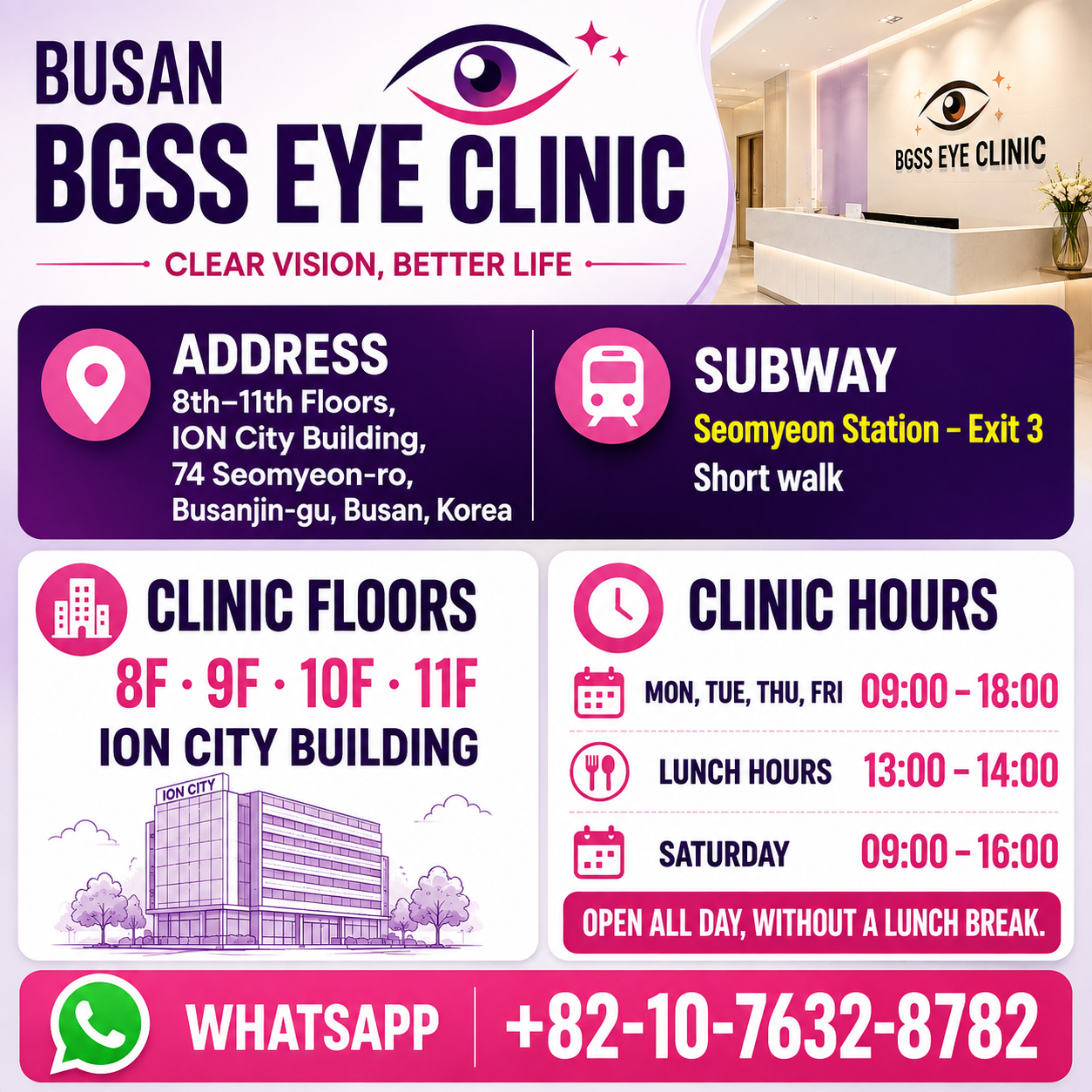
For example, BGSS Eye Clinic is located at 74 Seomyeon-ro in Busanjin-gu and provides cataract evaluation and treatment services. The clinic describes its Busan center as including dedicated cataract and presbyopia examination facilities.
For international patients, the area can be particularly practical because it is centrally located and accessible by public transportation.
International Patient Support May Be Available
Some Busan eye clinics provide English or multilingual assistance for foreign patients.
BGSS Eye Clinic, for example, states that it provides English-speaking support and services for international patients seeking cataract evaluation and treatment.
This can be helpful when discussing detailed medical information, IOL choices, surgery planning, and postoperative instructions.
What Happens When You Arrive?
Registration and Medical History
Your appointment will generally begin with registration and collection of basic medical information.
You may be asked about:
- Current vision problems
- Previous eye surgery
- Existing eye conditions
- Current medications
- Previous glasses prescriptions
- Contact lens use
- General health conditions
- Previous laser vision correction
If you have had LASIK, PRK, LASEK, or SMILE, tell the ophthalmologist.
Previous refractive surgery can be relevant when planning cataract surgery and calculating IOL power.
Explain Your Actual Vision Problems
Do not simply say that your vision is "blurry."
Try to describe exactly what has changed.
For example:
- "Headlights are too bright at night."
- "I cannot read restaurant menus easily."
- "My right eye is much worse."
- "Colors look less vivid."
- "My glasses no longer make my vision clear."
- "I have difficulty seeing in dim lighting."
These details help the ophthalmologist understand how the cataract affects your daily life.
What Tests Are Included in a Cataract Consultation?
Visual Acuity Testing
One of the first tests measures how clearly you can see at different distances.
The clinic may measure:
- Uncorrected vision
- Corrected vision
- Near vision
- Distance vision
However, visual acuity is only one part of a cataract assessment.
A patient can have a relatively good eye-chart result but still experience significant glare or difficulty with night vision.
Refraction
Refraction determines whether a different glasses prescription could improve your vision.
This is important because some patients with early cataracts can still obtain useful improvement with updated glasses.
If vision remains unsatisfactory despite appropriate correction, the cataract may be contributing more significantly to the problem.
Slit-Lamp Examination
A slit-lamp examination allows the ophthalmologist to examine the front structures of the eye under magnification.
The natural lens can be evaluated for:
- Cataract type
- Cataract location
- Degree of lens opacity
- Other lens abnormalities
The ophthalmologist can also assess the cornea, iris, and other anterior eye structures.
Eye Pressure Measurement
Eye pressure may be measured as part of a comprehensive ophthalmic evaluation.
This helps identify patients who may have elevated intraocular pressure or other concerns requiring additional assessment.
Retinal Examination
The retina is important because cataract surgery removes the cloudy lens, but it cannot reverse vision loss caused by retinal disease.
The ophthalmologist may examine the retina to look for conditions such as:
- Macular disease
- Diabetic retinal changes
- Retinal degeneration
- Other abnormalities
Understanding retinal health helps establish realistic expectations for cataract surgery.
What Additional Tests May Be Needed Before Cataract Surgery?
Optical Biometry
If surgery is being considered, precise eye measurements are required to calculate the appropriate IOL power.
Biometry may measure characteristics such as:
- Eye length
- Corneal curvature
- Anterior chamber dimensions
These measurements contribute to IOL calculations.
Corneal Measurements
Corneal measurements can help evaluate astigmatism and determine whether a toric IOL or another approach may be appropriate.
Corneal shape is particularly important when planning premium or astigmatism-correcting lenses.
Macular or Retinal Imaging
Additional retinal imaging may be recommended when clinically appropriate.
This can help identify retinal conditions that might affect the expected visual outcome after cataract surgery.
Not every patient requires every available test. The exact examination depends on your symptoms, eye health, medical history, and surgical plan.
How Is the Cataract Itself Evaluated?
Not All Cataracts Affect Vision in the Same Way
Cataracts can develop in different parts of the natural lens.
The type and location of the opacity can influence symptoms.
Some patients primarily experience:
- Distance blur
- Near-vision difficulty
- Glare
- Halos
- Reduced contrast
- Poor night vision
- Changes in color perception
The ophthalmologist will evaluate the lens and determine whether the cataract is likely responsible for your symptoms.
Your Symptoms Matter as Much as the Examination
A cataract may appear relatively mild but still create significant glare or functional problems for certain patients.
Conversely, another patient may have a more noticeable cataract but remain comfortable with glasses.
This is why treatment decisions should be individualized.
Will the Doctor Recommend Cataract Surgery?
Surgery Depends on Functional Vision
There is no single age at which everyone should undergo cataract surgery.
Instead, the decision generally considers:
- How much your vision is affected
- Whether glasses still provide adequate correction
- Whether daily activities are limited
- Your overall eye health
- Your visual goals
- The potential benefits and risks of surgery
If the cataract is not significantly affecting your life, observation may be reasonable.
If you can no longer drive comfortably at night, read normally, work effectively, or enjoy everyday activities, surgery may become a more appropriate discussion.
What IOL Options Might Be Discussed?
Monofocal IOLs
A monofocal IOL is designed to provide clear vision at one primary distance.
For many patients, this is a straightforward and predictable option.
Depending on the selected target, reading glasses may still be necessary.
Toric IOLs
If you have suitable corneal astigmatism, a toric IOL may be considered.
It is designed to reduce astigmatism while replacing the cloudy natural lens.
Not every patient with astigmatism is automatically a candidate, so precise measurements are important.
Multifocal IOLs
Multifocal lenses are designed to provide vision at more than one distance.
They may reduce dependence on glasses for some patients, but they can also produce optical phenomena such as halos or glare.
The benefits and trade-offs should be discussed carefully before choosing this type of lens.
EDOF IOLs
Extended-depth-of-focus lenses are designed to provide a broader range of functional vision than a conventional monofocal lens.
They may be considered for selected patients who want greater independence from glasses.
However, lens selection must be individualized based on eye health, lifestyle, and expectations.
Can You Ask About Premium Cataract Lenses in Busan?
Yes, But Suitability Comes First
Patients often search for premium lens options because they want to reduce their dependence on glasses.
During your consultation, you can ask whether you may be suitable for:
- Multifocal IOLs
- EDOF IOLs
- Toric IOLs
- Enhanced monofocal lenses
- Other available lens technologies
The best lens is not necessarily the most expensive lens.
Your ophthalmologist should consider your cornea, retina, optic nerve, tear film, astigmatism, lifestyle, and visual expectations before recommending an IOL.
What Should International Patients Bring?
Previous Eye Records
If you are traveling to Korea for a cataract consultation, bring any previous medical information you have.
Useful documents may include:
- Current glasses prescription
- Previous eye examination results
- Retinal scans
- Previous cataract evaluations
- Contact lens history
- Previous eye surgery records
- LASIK or PRK records
- SMILE records
- Medication list
The more complete your history, the easier it can be for your ophthalmologist to understand your eyes.
Tell the Clinic About Your Travel Schedule
If you are visiting Busan temporarily, explain your travel dates before scheduling surgery.
A consultation and surgery should not necessarily be compressed into an unrealistic itinerary.
You need to allow enough time for:
- Diagnostic testing
- Treatment planning
- Surgery if recommended
- Postoperative assessment
- Any additional follow-up recommended by your ophthalmologist
BGSS Eye Clinic specifically advises international patients to allow sufficient time for examination, lens consultation, surgery, and follow-up during their stay.
Should You Wear Contact Lenses Before the Examination?
Ask the Clinic About Contact Lens Restrictions
Contact lenses can temporarily affect corneal measurements.
If you currently wear contact lenses, ask the clinic whether you should stop wearing them before specific measurements.
The appropriate discontinuation period can vary according to the type of lens and the examination being performed.
Do not assume that the same preparation applies to every patient.
What Questions Should You Ask During the Consultation?
Questions About Your Cataract
Consider asking:
- How advanced is my cataract?
- Is the cataract responsible for my blurry vision?
- Could glasses still improve my vision?
- Is one eye more affected than the other?
- How quickly is the cataract likely to progress?
- Is there any retinal or corneal condition affecting my vision?
Questions About Surgery
If surgery is recommended, ask:
- Do I need surgery now?
- What happens if I wait?
- Which IOL is appropriate for me?
- Will I still need reading glasses?
- Do I have astigmatism?
- Would a toric lens be appropriate?
- Am I suitable for a multifocal or EDOF lens?
- What are the main risks?
- What should I expect during recovery?
Questions for International Patients
If you are traveling from overseas, also ask:
- How many visits are required?
- How long should I stay in Busan?
- When can I fly after surgery?
- When is my first postoperative check?
- What happens if I develop a problem after returning home?
- Can I receive a copy of my medical records?
- Is English-language support available?
These questions can help you plan your trip realistically.
How Long Does a Cataract Consultation Take?
The Time Depends on the Examination
There is no universal appointment length.
A simple consultation may be shorter than a comprehensive surgical evaluation involving multiple measurements.
If you are being assessed specifically for cataract surgery, allow enough time for diagnostic testing and discussion rather than scheduling another activity immediately afterward.
BGSS Eye Clinic states that its Busan center includes dedicated examination, consultation, cataract, and presbyopia facilities.
Do You Need to Book in Advance?
International Patients Should Plan Ahead
If you are visiting Seomyeon specifically for cataract evaluation, advance scheduling is recommended.
BGSS Eye Clinic states that appointments are by reservation and that it does not accept walk-in visits.
This is particularly important for international visitors who have limited time in Busan.
Contact the clinic before traveling to confirm:
- Appointment availability
- Required documents
- Language support
- Examination preparation
- Expected appointment duration
- Whether surgery can be scheduled after consultation
How Much Does a Cataract Consultation Cost in Busan?
The Price Depends on the Examination
There is no single universal price for a cataract consultation.
Costs can vary depending on:
- Number of diagnostic tests
- Imaging requirements
- Biometry
- IOL planning
- Whether additional eye conditions need evaluation
- Whether the appointment is part of a surgical package
For international patients, it is reasonable to ask for a detailed breakdown before the appointment.
Cataract surgery costs can also vary according to lens selection, technology, eye anatomy, and treatment complexity.
What Happens If You Are Not Ready for Surgery?
Monitoring May Be Appropriate
If the cataract is mild, the ophthalmologist may recommend observation rather than immediate surgery.
You may continue using:
- Prescription glasses
- Reading glasses
- Brighter lighting
- Sunglasses
- Other simple visual aids
Regular examinations can monitor whether the cataract is progressing.
A Consultation Is Still Useful
Even if you do not need surgery immediately, a consultation can establish a baseline.
You will know:
- How advanced the cataract is
- Whether another eye condition is involved
- What changes to watch for
- When you should return for another examination
What If You Are Ready for Cataract Surgery?
The Consultation Becomes the Foundation for Surgical Planning
If surgery is appropriate, the consultation helps establish your treatment plan.
This may include:
- Confirming the cataract diagnosis
- Measuring the eye
- Assessing astigmatism
- Evaluating the retina
- Choosing an IOL category
- Setting your visual target
- Discussing risks
- Planning follow-up
The goal is not simply to remove the cataract.
The goal is to select a treatment approach that fits your eyes and your visual priorities.
Why Choosing the Right IOL Matters
Your Lifestyle Should Influence the Decision
Tell your ophthalmologist how you use your vision.
For example, do you:
- Drive frequently?
- Read extensively?
- Work on computers?
- Travel often?
- Play sports?
- Use a smartphone for long periods?
- Prefer to minimize reading glasses?
These details can influence the discussion about IOL options.
A person who prioritizes excellent distance vision may have different priorities from someone who wants broader spectacle independence.
What Should You Expect After the Consultation?
You Should Leave With a Clearer Understanding
A useful cataract consultation should answer several basic questions:
Do I have a cataract?
Is it causing my vision problems?
Do I need surgery now?
If surgery is recommended, what lens options are appropriate?
What should I expect during recovery?
How should I plan if I am an international patient?
If these questions remain unclear, ask the ophthalmologist or patient coordinator to explain them before making a decision.
Cataract Consultation in Seomyeon: A Practical Checklist
Before Your Appointment
- Gather previous eye records.
- Bring your current glasses.
- Write down your main vision problems.
- List your medications.
- Tell the clinic about previous eye surgery.
- Ask about contact lens restrictions.
- Confirm language support.
- Confirm appointment time.
- Tell the clinic your travel dates if you are visiting Korea.
During the Appointment
- Describe your real-world visual problems.
- Ask whether glasses can still help.
- Ask whether the cataract is visually significant.
- Discuss astigmatism.
- Ask about IOL choices.
- Ask about realistic visual expectations.
- Discuss recovery and follow-up.
Before Scheduling Surgery
Make sure you understand:
- The recommended procedure
- The selected IOL
- The reason for the lens choice
- Potential risks
- Expected recovery
- Follow-up schedule
- Total treatment costs
- International travel considerations
Conclusion
A cataract consultation in Seomyeon, Busan is more than a test to determine whether your vision is blurry. It is an opportunity to identify the cause of your visual problems, evaluate the health of your eyes, determine whether cataract surgery is appropriate, and discuss the most suitable IOL options.
For international patients, preparation is particularly important. Bring previous eye records, explain your symptoms clearly, inform the clinic about your travel schedule, and allow enough time for diagnostic testing and follow-up.
If surgery is recommended, do not feel pressured to choose a lens simply because it is described as "premium." The most appropriate IOL depends on your eye health, visual goals, lifestyle, and realistic expectations.
Seomyeon offers convenient access to ophthalmology services in central Busan, including clinics providing cataract evaluation and surgical planning for international patients.
Ultimately, the best cataract treatment plan starts with an accurate diagnosis and a detailed conversation with an ophthalmologist.
A good consultation should leave you understanding not only what is wrong with your vision, but also why a particular treatment may—or may not—be right for you.
FAQs About Cataract Consultation in Seomyeon, Busan
1. What happens during a cataract consultation in Busan?
A cataract consultation may include visual acuity testing, refraction, slit-lamp examination, eye pressure measurement, retinal evaluation, and additional measurements if surgery is being considered. IOL calculations and corneal measurements may also be performed.
2. Can international patients have a cataract consultation in Seomyeon?
Yes. Eye clinics in Seomyeon provide cataract evaluation and treatment services, and some specifically offer support for international patients.
3. Do I need to have cataract surgery immediately after the consultation?
No. The consultation determines whether surgery is appropriate. If the cataract is mild and your vision remains functional, monitoring or updated glasses may be recommended.
4. What should I bring to a cataract consultation in Korea?
Bring your glasses, previous eye examination records, prescription history, medication list, and records of previous eye surgery such as LASIK, PRK, LASEK, or SMILE if applicable.
5. Can I discuss premium IOLs during my consultation?
Yes. Depending on your eye health and measurements, your ophthalmologist may discuss monofocal, toric, multifocal, EDOF, or other IOL options.
6. Can cataract surgery correct astigmatism?
Cataract surgery can sometimes reduce corneal astigmatism through an appropriate surgical plan or toric IOL. Whether you are a suitable candidate depends on the type and amount of astigmatism.
7. How long should international patients stay in Busan for cataract treatment?
There is no single schedule for every patient. The required stay depends on examination findings, the procedure, recovery, and postoperative follow-up. International patients should plan enough time for evaluation, surgery if recommended, and follow-up.
8. Can I have a cataract consultation without deciding on surgery?
Yes. A consultation can be used to understand your diagnosis, assess progression, and determine whether surgery is currently appropriate.
9. Do Seomyeon eye clinics accept walk-in cataract consultations?
Policies vary by clinic. BGSS Eye Clinic states that its appointments are by reservation and that it does not accept walk-ins, so international patients should arrange an appointment in advance.
10. Why is a comprehensive eye examination important before cataract surgery?
It helps determine whether the cataract is causing your symptoms, evaluates other eye conditions, measures the eye for IOL calculation, assesses astigmatism, and helps establish realistic expectations for the surgical outcome.